
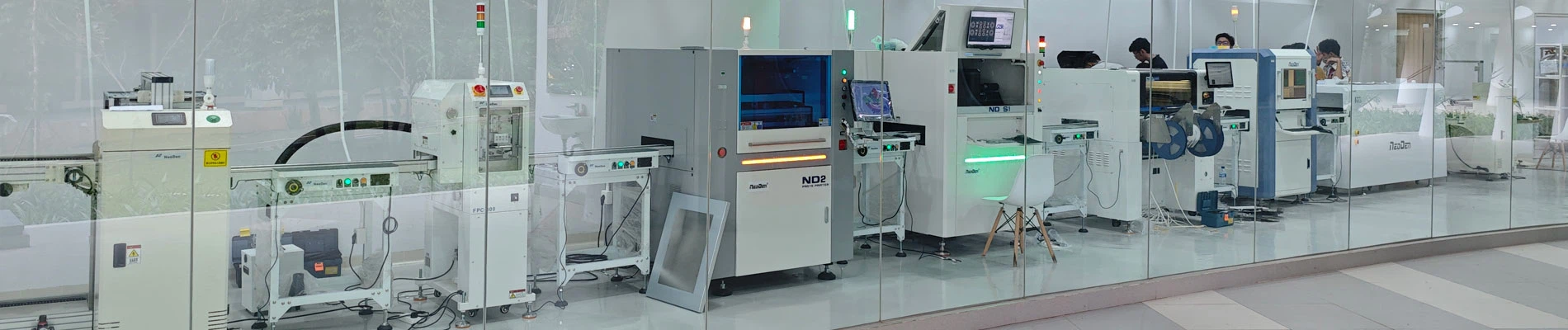

Introduction
A complete SMT fully automated production line consists of seven core stages. This article outlines the key roles and selection criteria for each process and, in conjunction with NeoDen's modular solutions, helps electronics manufacturing enterprises (EMS factories, small and medium-sized manufacturers, and R&D laboratories) build efficient PCB assembly production lines with low defect rates.
Standard SMT Automation Production Process Flow
[1. Solder Paste Printer] ➔ [2. 3D SPI Inspection] ➔ [3. Pick-and-Place Machine] ➔ [4. Reflow Soldering] ➔ [5. AOI Optical Inspection] ➔ [6. X-Ray Internal Inspection] ➔ [7. PCB Buffer Conveyor]

Step 1: Automated SMT Solder Paste Printer
- Key Function: The first step in SMT assembly. Solder paste is precisely dispensed onto the PCB pads through a stencil, laying the foundation for subsequent soldering.
- Why Auto Solder Paste Printer: Fully automatic solder paste printers can precisely control squeegee pressure, printing speed, and visual alignment, effectively preventing issues such as cold solder joints, solder bridges, and excess or insufficient solder, thereby ensuring batch consistency.
-
NeoDen Solution - ND450 Automatic Solder Paste Printer
- Design Highlights: Features an electric + air-float squeegee system, a precision three-axis adjustment platform, and the Mark vision calibration system.
- Application Scenarios: Suitable for PCB R&D prototyping, small-to-medium batch manufacturing, and EMS contract manufacturers, reducing printing offset and repeatability errors.
Step 2: 3D SPI Solder Paste Inspection Equipment
- Core Function: Performs 3D digital inspection of solder paste prior to component placement. Statistics show that over 60% of SMT assembly defects originate from the printing process; SPI can intercept defects at the source, avoiding costly post-production rework expenses.
-
NeoDen Solution - NeoDen S1 SPI Inspection System
- Precise Measurement: Real-time detection of solder paste height, volume, area, shape, and printing offset.
- Intelligent Management: Supports rapid import of Gerber/CAD data and SPC statistical analysis, significantly improving first-pass yield (FPY).
Step 3: SMT Pick and Place Machine
- Core Function: The primary source of production capacity on the SMT production line, responsible for placing components such as resistors, capacitors, IC chips, and BGAs at designated locations with high speed and micrometer-level precision.
- Key Selection Criteria: Placement speed (CPH), vision recognition capability (to handle 0201/01005 and high-density ICs), and feeder station capacity.
-
NeoDen Solution - N10P High Speed Pick and Place Machine
- Production Capacity Breakthrough: 8-head configuration with a maximum speed of 20,000 CPH.
- High-Capacity Feeding: Supports up to 80 Tape & Reel Feeder stations, reducing the frequency of downtime for material changes.
- Multi-Level Vision Compensation: Equipped with dual mark cameras, a flying camera, and a dedicated IC camera to automatically correct component angle and position deviations.
Step 4: SMT Reflow Oven
- Core Function: By precisely controlling the temperature profile (preheating, constant temperature, reflow, cooling), the solder paste is melted and bonded to the PCB pads to form reliable solder joints.
- Selection Criteria: Independent temperature control across multiple zones, uniformity of hot air circulation, and PID temperature control accuracy.
-
NeoDen Solution - NeoDen IN12C Intelligent 12-Zone Reflow Oven
- Precise Temperature Control: 12 independent temperature zones enable fine-tuned adjustment of the temperature rise curve, easily handling BGA, QFN, and high-density PCBs.
- Hot Air Circulation: Uniform heat distribution effectively eliminates defects such as cold solder joints and thermal shock.
Step 5: AOI (Automatic Optical Inspection)
- Core Function: Replaces traditional manual visual inspection to quickly identify surface defects such as component misplacement, omissions, reversed polarity, misalignment, and solder bridges.
| AOI Deployment Location | Core Inspection Objectives |
| Post-Printing AOI | Inspects pad solder paste integrity and surface contamination |
| Post-Placement AOI | Intercepts incorrect component placement, misalignment, and polarity errors prior to reflow soldering |
| Post-Reflow AOI (Recommended) | Final quality control; 100% inspection of solder joint quality and assembly anomalies |
Step 6: X-Ray Non-Destructive Internal Inspection Equipment
- Key Role: Compensates for blind spots in optical inspection. For bottom-side hidden solder joints in BGA, CSP, QFN, and similar packages, X-ray penetrates the components to accurately detect internal defects such as cold solder joints, porosity, and solder ball bridging.
-
NeoDen Solution - ND56X Precision Microfocus X-Ray Inspector
- High-Definition Imaging: A 40–90 kV microfocus X-ray tube (15 μm focal spot) paired with a dynamic flat-panel detector provides high-definition views of chip and internal solder joint structures.
- Multi-Angle Inspection: Supports ±30° tilt and 360° rotation to eliminate inspection blind spots.
- Automated Analysis: Supports CNC multi-point automatic inspection and automated generation of inspection reports, meeting the demands of high-reliability industries such as automotive electronics and medical devices.
Step 7: SMT Conveyor and Buffer System
- Core Function: Runs through the entire SMT production line to enable automated PCB transfer between equipment. The buffer system balances cycle time differences between processes (e.g., high-speed placement and constant-speed reflow soldering), prevents production bottlenecks, and enhances the line's scalability for future upgrades.
Why Choose NeoDen to Build a Complete SMT Automation Production Line?
- One-stop coverage of the entire process: From feeding, printing, and placement to inspection, this significantly reduces the costs associated with coordinating multiple suppliers and after-sales service.
- Flexible scalability: Supports R&D prototyping, small-batch pilot production, and medium-scale automated production.
- Professional solution support: We provide factory production line layout planning, equipment selection recommendations, and comprehensive technical services.
