
Introduction
Reflow oven is a pre-printed on the PCB pads by heating the solder paste melting, so as to achieve the surface assembly components solder ends or pins and PCB pads between the mechanical and electrical connection of the soldering process. This article will help SMT novices understand some common terms for reflow oven. Learning the common terminology of reflow oven has these roles:
- Improve communication efficiency
- Optimize process design and problem solving
- Support technological innovation and knowledge accumulation
- Enhance professional competitiveness

I. The basic concept of reflow soldering machine
1. The working principle of reflow soldering machine
The basic principle of reflow oven is based on the thermal expansion and contraction properties of matter. Soldering process, the solder paste is heated above the melting point, solder powder melts and spreads to the component pins and PCB pads between the formation of a solid welding point. The flux plays a role in this process to reduce the surface tension at the joint, promoting the uniform flow and bonding of the solder. Subsequently, with the gradual decrease in temperature, the solder cooling curing, complete the welding process.
2. The main application areas of reflow soldering machine
- Electronics industry: Circuit board installation, SMT technology, manufacturing and repair of PCB.
- Communication industry: Optoelectronic device welding, high-voltage cable welding.
- Automotive industry: for automotive circuit board welding and parts installation, to ensure the reliability and durability of automotive electronic components.
- Household appliance industry: for the installation and welding of circuit boards, components and solder joints in various household appliances
- Aerospace industry: Launchers welding
II. The common terminology analysis
1. Solder
Solder is used to fill in the weld, cladding and brazing in the metal alloy material of the general term. Including welding wire, welding rod, brazing and soldering alloy.
1.1 What are the commonly used solder?
Different melting points: Hard solder and soft solder.
Different composition: Tin-lead solder, silver solder, copper solder, etc.
1.2 Soldering temperature
- Pre-heating zone: The temperature is usually between 150 - 200°C. The temperature of the soldering zone is usually between 150 - 200°C. The main purpose of this stage is to allow the circuit board and components to heat up slowly and evenly.
- Holding zone: The temperature is usually maintained at about 180 - 220°C. The solder paste in this temperature zone is not heated up. In this zone, the flux in the solder paste is in full effect, removing oxides from the component pins and the surface of the circuit board pads, and at the same time keeping the paste in a suitable viscosity state, ready for subsequent reflow soldering.
- Reflow zone: The temperature is generally between 220 - 260°C. The solder paste is completely melted in this zone. In this zone the solder paste is completely melted and a good solder joint is formed.
- Cooling zone: Allows the solder joint to cool and solidify quickly to form a stable crystal structure and improve the strength of the solder joint. The cooling rate is usually controlled at 2 - 5°C/s.
2. Solder Paste
Solder paste is a kind of electronic soldering material, is the solder powder and the appropriate amount of flow agent mixed together to form a paste, used for surface mounting or soldering electronic components.
2.1 Types of solder paste
- Lead-containing solder paste: Lead-containing solder paste in the soldering process has a low melting point and excellent soldering performance, but due to environmental reasons, the use of the gradual decrease.
- Lead-free solder paste: in line with the trend of environmental protection, widely used in a variety of requirements for environmentally friendly electronic product manufacturing. Lead-free solder paste can be divided into high-temperature lead-free solder paste, medium-temperature lead-free solder paste and low-temperature lead-free solder paste.
2.2 Precautions for the use of solder paste
- Storage conditions: solder paste should be sealed and stored in a refrigerator at 2-10°C. The validity period is generally 3-6 months. Use the principle of first-in-first-out.
- Re-warming and Stirring: The solder paste taken out of the refrigerator needs to be re-warmed at room temperature for 2-4 hours, avoiding the use of external heating devices. After rewarming, use a SMT solder mixer or manually stir the solder paste to ensure that the flux is evenly mixed with the tin powder.
- Amount of solder paste used and printing conditions: The amount of solder paste used should be added in small quantities to avoid adhering to the squeegee. Squeegee hardness is generally Shaw's hardness 80-90 degrees, the material is rubber or stainless steel, the speed is 10-150mm/sec, the angle is 60-85 °. Stainless steel or wire mesh can be chosen as the material of the mesh plate. The operating environment temperature should be kept at 25±5℃.
- Handling after solder paste printer printing is completed: The solder paste printed patch should be reflow soldered within 1 hour to avoid prolonged exposure to air.
3. Printed Circuit Board
3.1 The basic structure of the circuit board
- Substrate: Usually use glass fiber reinforced epoxy resin or phenolic resin cardboard (such as FR-4), the substrate provides mechanical support for the circuit board.
- Conductive layer: Copper foil is used as a conductive material to form various circuit paths on the circuit board for the transmission of electrical signals.
- Solder Resist Layer: In order to avoid short-circuiting of the copper foil conductive layer, the surface of the circuit board is covered with a green solder resist layer, which serves as protection and insulation.
- Character marking: Used to mark the location of components and other information to facilitate installation and maintenance.
3.2 How to choose a suitable PCB for reflow oven
- Simple circuits: Single-layer boards or double-layer boards can meet the requirements.
- High-performance applications (servers, communication devices, etc.):
- It is recommended to choose PCBs with high multilayer products, which can meet the requirements of high-density wiring and high signal integrity.


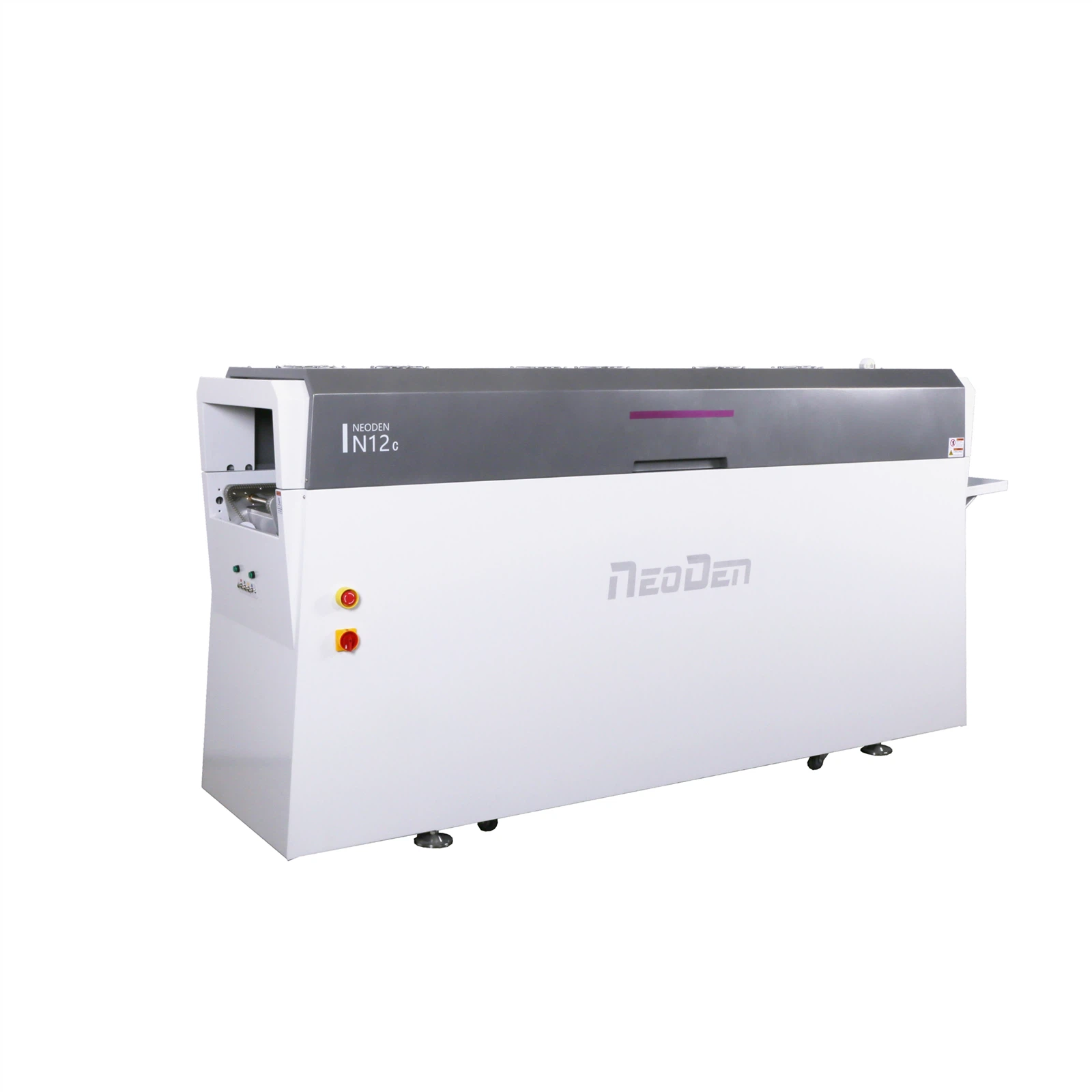
4. Reflow oven
Reflow oven is an important equipment in electronic manufacturing, mainly used in the reflow soldering process will be solder heating, melting and curing to ensure that the electronic components and printed circuit boards (PCB) to achieve a good electrical connection between. The main functions are as follows:
- Heating: Soldering is achieved by gradually heating the solder paste to its melting point.
- Controlling temperature profile: The reflow oven ensures accurate control of the temperature profile by setting different heating zones to cope with different types of solder and PCB materials.
- Cooling: After the soldering is completed, the temperature is quickly reduced to ensure the reliability of the soldering point.
5. Heat conduction
Heat conduction refers to the process of heat transfer through the interior of an object or between objects that are in contact with each other, from the area of higher temperature to the area of lower temperature. Factors affecting the efficiency of heat transfer are listed below:
- Material properties: Including thermal conductivity, heat capacity, contact surface quality and interface thermal resistance.
- Process design: Including PCB layout, solder selection, PCB layers and heat dissipation through-hole design.
- Equipment performance: Including heating mode, furnace design and conveyor parameters.
- Environmental factors: Including atmosphere environment and workshop conditions.
6. Cooling
6.1 The need for cooling
- Prevent damage caused by thermal stress.
- Optimize the microstructure of solder joints and improve mechanical properties.
- Reduce the effect of flux residues.
- Improve productivity and reduce energy consumption.
6.2 Commonly used cooling methods
Natural cooling, forced air cooling, water cooling, liquid nitrogen cooling and segmented cooling. Specific selection should be based on product characteristics, process requirements and equipment conditions for comprehensive consideration.
6.3 Effect of cooling rate on welding quality
- Welded joint microstructure: Cooling rate affects grain size and IMC layer formation.
- Thermal stress management: Improper cooling rate may lead to thermal stress concentration, triggering solder joint cracking or PCB warpage.
- Flux Residue: Cooling rates that are too fast or too slow increase the risk of flux residue.
- Solder Joint Wettability: The cooling rate needs to be matched to the solder characteristics to ensure good wetting.
- Product reliability: The cooling rate of the solder joint fatigue resistance and long-term stability has an important impact.
III. The reflow soldering process common problems and solutions
1. Tin ball
Tin ball is the appearance of small balls of solder on the surface of the solder joint. This is usually due to the welding temperature is too high, welding time is too long or welding area design is not reasonable.
Solution: Adjust the soldering temperature and time to ensure that the soldering parameters meet the requirements. Check the design of the soldering area to ensure a reasonable layout of the soldering points.
2. Cold welding
Cold welding means that the welded joints do not reach a sufficiently molten state, resulting in a weak connection of the welded joints. This may be caused by insufficient welding temperature, insufficient welding time or improper design of the welding area.
Solution: Increase the soldering temperature and time to ensure that the solder joints are completely melted. Check the design of the soldering area to ensure that the soldering point has good contact with the components.
3. Tinning
Tinning is the formation of a bridge of melted solder between two or more neighboring solder joints. This is usually due to too high a welding temperature, welding time is too long or welding area design is not reasonable.
Solution: Reduce the soldering temperature and time to ensure that there is no excessive melting between solder joints. Check the design of the welding area to ensure that the layout of the welding points is reasonable.
4. Welding offset
Welding offset refers to a certain error between the welding position and the intended position. This may be caused by problems with the welding equipment or fixtures.
Solution: Check the welding equipment and fixtures to ensure their stability and accuracy. Adjust the welding parameters and process to ensure the accuracy of the welding position.
Conclusion
Learning reflow oven terminology is important for communication efficiency, process optimization, technological innovation, standardization compliance, and career advancement. Learning and applying these terms in a systematic manner is an essential part of any person's career in electronics manufacturing. Beginners should continue to learn and practice.

Company profile
Zhejiang NeoDen Technology Co., LTD., established in 2010 with 100+ employees & 8000+ Sq.m. factory of independent property rights, to ensure the standard management and achieve the most economic effects as well as saving the cost.
Owned the own machining center, skilled assembler, tester and QC engineers, to ensure the strong abilities for NeoDen machines manufacturing, quality and delivery.
40+ global partners covered in Asia, Europe, America, Oceania and Africa, to successfully serve 10000+ users in all of the world, to ensure the better and faster local service and prompt response.
3 different R&D teams with total 25+ professional R&D engineers, to ensure the better and more advanced developments and new innovation.