

For many hardware startups and R&D teams, outsourcing PCB assembly sounds convenient at first.
But once the project enters continuous debugging and small-batch iteration, outsourcing quickly becomes one of the biggest bottlenecks in product development.
A simple resistor value change may mean:
- waiting for a new stencil
- sending updated Gerber and BOM files
- paying another setup fee
- waiting several more days for assembly
For teams doing rapid prototype validation or NPI (New Product Introduction), the real problem is often not assembly cost itself.
It's the waiting time.
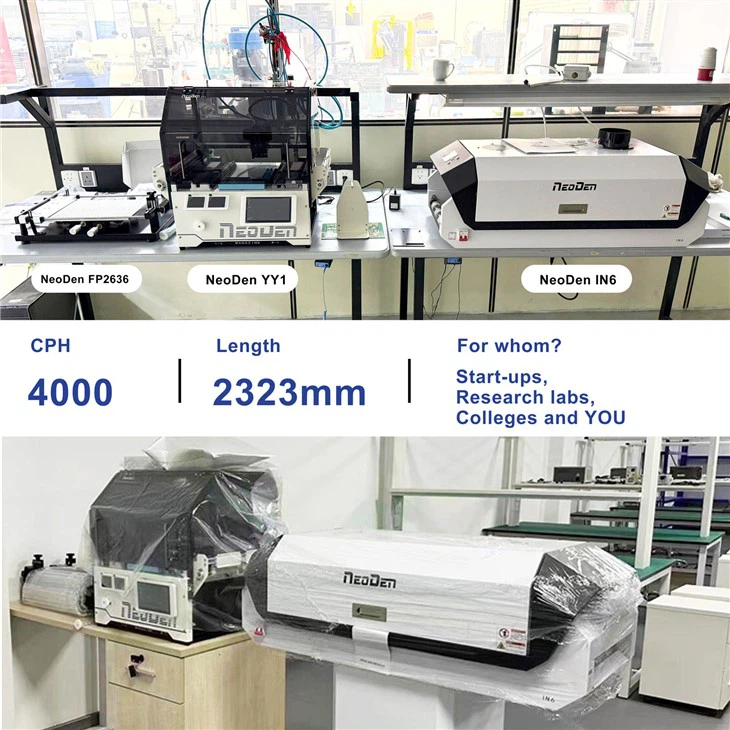
This is exactly where a desktop SMT pick and place machine like the NeoDen YY1 becomes valuable.
Instead of waiting for external factories to queue your order, engineers can finish:
- stencil printing
- component placement
- reflow soldering
inside the office or lab within the same afternoon.
Why Small-Batch PCB Assembly Becomes Expensive So Quickly?
Most PCB assembly factories are optimized for volume production.
Their profit model depends on:
- stable production schedules
- repeated PCB designs
- long production runs
But during prototype stages, engineers usually face:
- constant BOM modifications
- PCB layout revisions
- firmware debugging
- connector position changes
- component substitutions caused by shortages
This means every small revision may trigger:
- engineering setup fees
- stencil remake costs
- minimum order quantity requirements
- repeated shipping costs
In many cases, the actual PCB assembly cost is not high.
The expensive part is repeatedly restarting the manufacturing process.
What YY1 Actually Changes in Daily SMT Work
The biggest advantage of the NeoDen YY1 is not simply "saving money".
It is shortening the hardware iteration cycle.
Instead of waiting several days for outsourced assembly, engineers can directly verify:
- component footprint correctness
- solderability
- connector alignment
- thermal design changes
- power circuit modifications
on the same day.
For hardware teams working on prototypes, this often matters more than pure placement speed.
YY1 Is More Suitable for NPI Than Mass Production
This is something many vendors avoid saying clearly.
YY1 is not designed to replace a high-speed SMT production line.
It is much more suitable for:
- prototype assembly
- engineering validation
- high-mix low-volume production
- R&D laboratories
- internal engineering departments
If your product already entered stable mass production with thousands of boards per month, large inline SMT lines with:
- automatic stencil printers
- AOI systems
- multi-head high-speed mounters
will still be more efficient.
YY1 solves a different problem:
fast engineering iteration
not ultra-high throughput manufacturing.
The Real SMT Problems YY1 Helps Solve
1. Avoiding "Empty Placement" During Production
One common problem on low-cost desktop pick and place machines is "empty placement".
The nozzle fails to pick a component, but the machine continues running as if nothing happened.
The PCB looks finished.
But after reflow, multiple components are missing.
YY1 integrates a vacuum detection module inside the placement head.
If:
- the feeder pocket is empty
- the tape is not peeled correctly
- the component drops during movement
- the nozzle leaks air
the system can detect abnormal vacuum pressure and stop or retry placement.
This becomes especially important for small packages like:
- 0402
- QFN
- DFN
where missing components are difficult to notice by eye during operation.
Why 0201 Components Often Fail During Pickup
Many beginners assume placement accuracy mainly depends on camera calibration.
In reality, feeder setup is equally important.
The YY1 manual specifically recommends setting the pickup position as close as possible to the component exposure point for tiny packages like 0201 and 0402.
In real SMT production, if the exposed tape area becomes too long:
- components can shift
- static electricity can move the part
- pickup angle becomes unstable
Experienced operators usually move the pickup point slightly forward to improve pickup consistency for very small components.
This is one of those small setup details that significantly affects continuous placement stability.
Why First-Time CSV Import Often Causes Placement Offset
YY1 supports direct CSV coordinate import from EDA software.
But this is also where many beginners encounter their first placement problems.
Several details are easy to overlook:
- Bottom layer origin must be set correctly
- Coordinates cannot contain negative values
- YY1 CSV structure should not be modified manually
Otherwise the machine may still load the file successfully, but actual placement positions can become globally shifted.
For first-board verification, it is usually safer to:
- place only a few components first
- verify polarity and alignment
- then continue full automatic placement
instead of immediately running the entire PCB.
This is also the workflow recommended in the manual.
Fiducial Setup Is More Important Than Many Beginners Realize
Many users assume:
"If the camera recognizes the fiducial, placement will automatically be accurate."
In reality, poor fiducial selection is one of the most common reasons for overall PCB offset.
The YY1 manual specifically warns that incorrect fiducial settings can cause placement deviation in the same direction across the entire PCB.
In practice, problems usually happen when:
- similar circular pads exist near the fiducial
- PCB reflections interfere with recognition
- low-contrast fiducials are used
For better recognition stability:
- use high-contrast round fiducials
- avoid nearby circular copper shapes
- keep the fiducial area visually clean
These small layout decisions often improve placement consistency more than people expect.
YY1 Is Easier to Learn Than Traditional Industrial Machines
Traditional SMT machines often require complicated industrial control programming.
YY1 simplifies much of this process through its embedded graphical interface and SD-card-based workflow.
For engineers already familiar with:
- PCB coordinate export
- component rotation
- fiducial concepts
basic placement jobs can usually be learned relatively quickly.
However, real SMT experience still matters when dealing with:
- feeder tuning
- nozzle selection
- pickup height
- tape peeling consistency
- fine-pitch components
The machine can simplify operation.
But stable SMT production still depends heavily on process setup.
Nozzle Selection Directly Affects Placement Stability
Many placement issues are actually nozzle selection problems.
The YY1 manual provides recommended nozzle ranges for different package sizes.
For example:
- CN030 → 0201
- CN040 → optimized for 0402
- CN100 → 0805 / 1206
- CN220 → SOP packages
- CN400 / CN750 → larger ICs
Using oversized nozzles often causes:
- unstable vacuum
- component rotation
- inaccurate centering
while undersized nozzles may fail to maintain reliable suction.
This becomes especially noticeable with:
- SOT packages
- LEDs
- lightweight passive components
Daily Maintenance Matters More Than Many People Expect
Most placement accuracy problems are not caused by camera calibration failure.
They usually come from basic maintenance issues.
For example:
- solder paste residue on nozzles
- worn feeder damping parts
- unstable tape peeling
- loose belts
- oxidized components
The YY1 manual specifically recommends keeping nozzles clean because solder paste residue directly affects placement quality.
In real production environments, many operators inspect nozzle condition before every production run, especially when handling small passive components.
When Should You Still Outsource PCB Assembly?
Even if you own a YY1, outsourcing still makes sense in many situations.
For example:
- mature products already in volume production
- high-speed continuous manufacturing
- very fine-pitch BGA assembly
- AOI-dependent production environments
- multi-thousand-board monthly demand
YY1 is strongest during:
- prototype development
- engineering validation
- rapid hardware iteration
- low-volume customization
not ultra-high-speed manufacturing.
Final Thoughts
For many hardware teams, the biggest advantage of an in-house SMT setup is not simply reducing assembly cost.
It is reducing engineering waiting time.
Being able to:
- modify a PCB in the morning
- place components in the afternoon
- test firmware the same evening
dramatically changes the pace of hardware development.
And for many small engineering teams, that speed advantage matters far more than pure SMT throughput.