
Introduction
In modern electronics manufacturing, R&D Lab, and maker spaces, the harmful gases and fumes generated during the soldering process have long been a concern for business owners and engineers.
As a desktop full-hot-air reflow soldering machine widely acclaimed in global markets, one of the NeoDen IN6's core competitive advantages is its innovative built-in soldering smoke filtering system, which helps reduce the impact of soldering fumes on the indoor environment. However, to maintain a smoke-free and toxin-free work environment over the long term and ensure the machine's performance does not decline, regularly replacing the filter cartridge is a critical maintenance task for preserving filtration efficiency and ensuring stable equipment operation.
This article, based on the official NeoDen IN6 user manual, brings you the most comprehensive, factory-level guide to filter cartridge replacement available online.

Why is regular replacement of the NeoDen IN6 filter a mandatory industrial safety requirement?
1. Blocking Harmful Gases
When soldering with the commonly used lead-free SAC305 solder paste, as the substrate enters the reflow zone and the temperature crosses the 217°C melting point to surge to a peak of 240°C–250°C, the activators and rosin media in the solder paste undergo violent thermal decomposition.
These aerosol fumes contain complex alkanes and acidic compounds. If the filter cartridge is not replaced for an extended period, the microporous structure of the filter mesh will become completely clogged with thick flux carbon deposits, causing a drastic drop in adsorption capacity.
2. How can a clogged filter cartridge affect the stability of the hot air circulation in reflow soldering?
- Increased duct resistance: When the filter cartridge in the built-in fume filtration system is not replaced for an extended period, a large amount of flux residue and particulate matter may accumulate within the filter layer, thereby increasing the static pressure in the air circulation system.
- Decreased hot air circulation efficiency: In certain high-load continuous production scenarios, filter cartridge clogging may affect the efficiency of hot air circulation within the oven. Even with the convection fan running continuously, the actual hot air flow (airflow velocity) within the temperature zone may still decrease, thereby affecting the consistency of heat exchange.
- Potential impact on temperature uniformity: When hot air circulation efficiency decreases, heat transfer in certain areas may become uneven, leading to slower temperature response or localized temperature fluctuations. In actual SMT production, such changes in thermal stability may further increase the following process risks:
- Incomplete Reflow
- Cold Solder
- Tin Balls
This is particularly true in lead-free soldering processes and high-density PCB production scenarios, where requirements for temperature curve stability are typically more stringent.
Official Standard Maintenance Cycle: Is It Time to Replace Your NeoDen IN6 Filter Cartridge?
Q1: What is the mandatory replacement cycle specified in the NeoDen user manual?
Refer to Section 9.3 "Machine Maintenance" on page 16 of the official manual, where the manufacturer provides an extremely clear quantitative standard: "The service life of the filter is 8 months (depending on the frequency of use)."
Q2: How should usage frequency be weighted in actual production environments?
- Prototyping and R&D Labs: If the equipment is only turned on for 2–3 hours per day for intermittent, high-frequency prototype production, the filter cartridge can strictly adhere to the 8-month replacement guideline.
- Small-batch production lines in small and medium-sized factories: If the workshop operates on a multi-shift, 24-hour continuous small-batch production schedule, the filter's lifespan is typically reduced to 4–6 months due to high solder paste throughput and extremely high concentrations of exhaust emissions.
Q3: What are the three "visually observable" warning signs that a filter cartridge has reached its saturation limit?
Even before the mandatory 8-month replacement cycle is reached, if any of the following three abnormalities are observed on-site, the filter cartridge must be inspected immediately:
- Weak exhaust airflow: When the equipment is running, place your hand near the fan exhaust port at the rear of the unit, if the airflow feels noticeably weaker or stuffy, this is a warning sign.
- Warmup Overtime: After startup, the equipment takes longer than the 20–30 minutes specified in the manual to heat from room temperature to the set equilibrium temperature.
- Unpleasant odor at the discharge outlet: When PCBs Offload zone cooling fans, a distinct, pungent rosin odor is detectable in the workshop air, indicating that the activated carbon layer is completely saturated.
NeoDen IN6 Filter Cartridge Replacement: Original Manufacturer-Grade Illustrated Guide
Filter cartridge replacement is a standard routine maintenance task that can be independently completed by on-site operators within 5 minutes. The required tools are very simple: one standard Phillips-head screwdriver, one brand-new NeoDen IN6 original manufacturer-grade activated carbon composite filter cartridge, and, in accordance with on-site maintenance protocols, IPA for auxiliary cleaning and a lint-free cloth.
Step 1: Safety Precautions-Completely Disconnect Power and Inspect Oven Cooling
The reflow oven operates at high temperatures and high power (maximum heat output reaches 2 kW). Before servicing the filtration system, you must completely unplug the 110V/220V AC single-phase power cord to fully disconnect the unit from the power grid.
Check the actual internal temperature of the oven via the control panel, you must wait until the entire temperature zone has cooled to below 40°C. At the same time, verify that the equipment is securely placed on a compliant ESD metal workbench. Under no circumstances should disassembly be attempted while the unit is powered on or when there is a risk of burns from high temperatures.
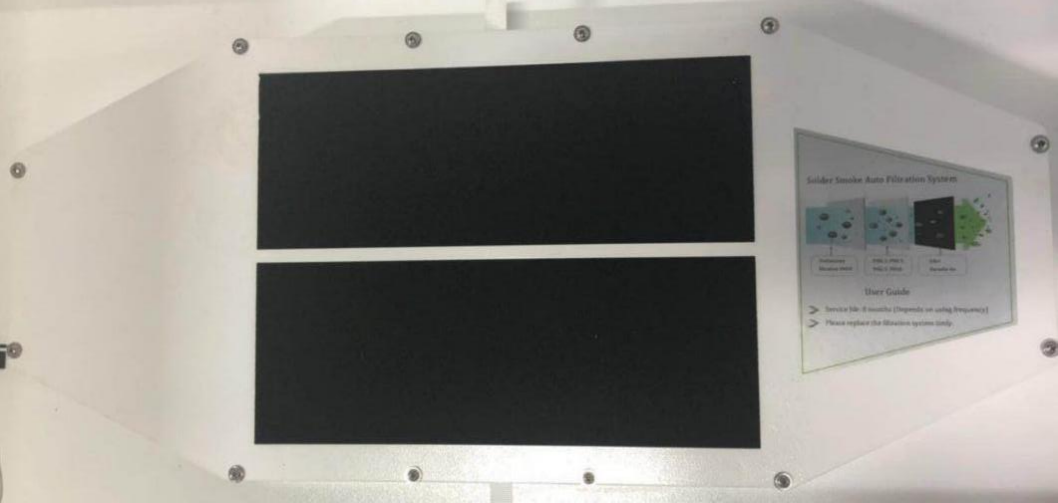
Step 2: Remove the 12 rear mounting screws symmetrically to unlock the purification chamber
Go to the rear of the NeoDen IN6 unit, where you will see the factory-designed independent purification chamber cover for the welding smoke filter system.
Using a Phillips screwdriver, remove the 12 mounting screws on the cover one by one at a steady pace, following the reverse order of the "diagonal crisscross tightening" method. Store the removed screws securely in an ESD-safe parts box. Gently remove the metal outer cover; the old smoke filter cartridge will now be fully exposed.
Step 3: Carefully Remove the Old Filter Cartridge, Degrease the Chamber, and Inspect the Air Ducts
Grasp the edge of the old filter cartridge's frame with your hand and pull it out of the filter chamber in a straight line. Since a large amount of viscous liquid flux residue has accumulated inside the old filter cartridge, take care to pull it out smoothly to prevent liquid from dripping onto the drive chain or circuit board below.
After removing the old filter cartridge, use a lint-free cloth dampened with an appropriate amount of industrial isopropyl alcohol (IPA) to carefully wipe the metal interior walls of the filter chamber. Pay special attention to cleaning flux coking that may have accumulated in the corners of the chamber. Check whether the rubber seal inside the chamber door retains good elasticity and shows no signs of deformation or aging to ensure optimal air duct sealing later on.
Step 4: Inserting the New Original Filter Cartridge, Securing It in Place, and Performing a One-Button Dynamic Preheating Test
Unpack the brand-new, factory-ordered NeoDen IN6 composite filter cartridge and check the airflow direction arrows on the filter frame. Ensure the arrow direction strictly matches the front-to-back airflow direction inside the unit, then carefully slide the new filter cartridge along the guide rails into the bottom.
Reattach the purifier chamber cover, reinstall the 12 mounting screws, and tighten them in two stages using a crisscross pattern to prevent air leaks caused by uneven pressure on one side.
Power-on Inspection: Reconnect the single-phase power supply and turn on the unit to activate the color touchscreen. Enter the system to load the standard Working files, then initiate the one-touch preheating test. Observe whether the equipment can reach the preset temperature field smoothly and without overshoot within 15–25 minutes. Verify at the exhaust outlet that the discharged gas is clean and free of any rosin odor. The replacement process is now complete.
Why is the use of inferior third-party replacement filters strictly prohibited?
- Incorrect airflow resistance matching can burn out the fan: Due to the lack of original manufacturer's aerodynamic simulation testing, third-party filters often have highly irregular mesh pore sizes and activated carbon particle compaction, easily resulting in initial airflow resistance several times higher than the original. This not only fails to improve hot air circulation but may also increase the fan's load and affect long-term stability.
- Insufficient carbon content renders purification ineffective: To cut costs, substandard filters feature extremely low iodine values (an indicator of adsorption capacity) and significantly reduced carbon layer thickness. Typically, they become completely saturated and fail within 1–2 weeks of installation, causing odors to resurface in the workshop and making it impossible to meet corporate environmental compliance requirements.
Conclusion
Regularly replacing the original NeoDen IN6 smoke filter cartridges is by no means a trivial, optional maintenance task. Rather, it is a critical, long-term investment in the health of your operational staff, safety protocols, and your company's first-pass yield for electronic component soldering. With just a 5-minute effort to loosen 12 screws, you can fully restore the equipment's airflow channels, ensure proper temperature control, and keep your SMT flexible assembly line running smoothly and sustainably on a green, toxin-free track.