

Introduction
As electronic products continue to evolve toward miniaturization, high density, and high reliability, an increasing number of electronics manufacturers are establishing their own fully automated SMT production lines.
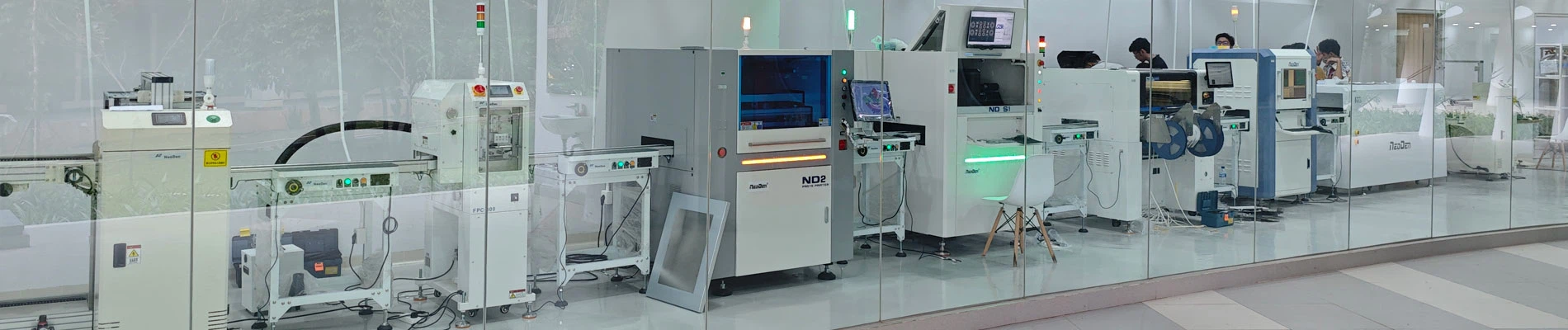
This article will provide a detailed overview of the core equipment required for a complete SMT automated production line. By integrating NeoDen's SMT solutions, it aims to help electronics manufacturers understand how to build a PCB assembly production line tailored to their specific needs.
A standard SMT automated production process typically includes:
Solder paste printing → SPI → Component placement by a pick-and-place machine → Reflow soldering → AOI → X-ray inspection → PCB conveyance and buffering
Each process step performs a distinct production task, and together they determine the final quality of the PCB assembly.
For example:
- Solder paste printing establishes the foundation for soldering
- SPI inspection helps detect solder paste printing anomalies early
- The SMT machine affects production efficiency and placement accuracy
- Reflow oven determines the reliability of solder joints
- AOI and X-ray ensure product quality

Step 1: SMT Solder Paste Printer
1. Why must an SMT production line be equipped with an automatic solder paste printer?
In the SMT production process, solder paste printing is the first step in the entire PCB assembly process and a critical stage that affects solder joint quality. Solder paste is precisely dispensed through a stencil onto the PCB pad locations, forming a reliable foundation for subsequent component placement and reflow soldering.
If problems occur during solder paste printing, even if the subsequent SMT placement machine has very high precision, this may lead to:
- Cold solder joints
- Solder balls
- Solder bridges causing short circuits
- Insufficient joint strength
- Increased PCB rework rate
Compared to traditional manual solder printing, automated SMT solder printing offers the following advantages:
- Higher printing consistency: Automated equipment can precisely control squeegee pressure, printing speed, the demolding process, and stencil positioning, reducing errors caused by human operation.
- Higher production efficiency: Automated solder paste printers can quickly complete PCB loading and unloading, vision alignment, and printing operations, making them better suited for continuous production environments.
- More consistent product quality: Through vision systems and precision mechanical structures, consistent solder paste printing results are ensured across different batches of PCBs.

2. NeoDen ND450 Automatic Solder Paste Printer Solution
Designed for small and medium-sized electronics manufacturers and SMT production scenarios requiring high flexibility, the NeoDen ND450 offers a stable, high-precision automatic solder paste printing solution.
Its core design features include:
- High-precision stencil clamping mechanism
- Automatic PCB positioning system
- Mark vision calibration function
- Precision three-axis adjustment platform
These design features help manufacturers reduce:
- Solder paste misalignment issues
- Under-fill/over-fill defects
- Repeatability errors in printing
Suitable for:
- PCB R&D and production
- Small-batch electronics manufacturing
- EMS factories
- Small- to medium-scale SMT production lines
For companies seeking to establish a stable SMT manufacturing process, the solder paste printer serves as a crucial starting point for the entire automated production line.
Step 2: 3D Solder Paste Inspection
1. Why Do Modern SMT Production Lines Need SPI Inspection?
If a PCB proceeds directly to the component placement stage after printing, any abnormalities in solder paste volume will typically carry over to the subsequent reflow soldering stage. This not only increases repair costs but may also affect production delivery. Therefore, an increasing number of automated SMT production lines are equipped with SPI equipment following the screen printer.
SPI uses 3D vision technology to perform digital inspection of the solder paste printing results.
Key inspection parameters include:
- Solder paste height
- Solder paste volume
- Solder paste area
- Solder paste shape
- Printing offset
Compared to manual visual inspection, SPI provides more precise and consistent data analysis.
2. NeoDen S1 SPI Solder Paste Inspection System
The NeoDen S1 SPI is a 3D solder paste inspection system designed for SMT production lines.
The system employs a high-precision vision system that uses industrial cameras and RGB lighting to analyze the solder paste printing condition on the PCB.
Its inspection capabilities include:
- Solder paste area measurement
- Solder paste volume measurement
- Solder paste height measurement
- Solder paste offset detection
It also supports:
- Gerber file import
- CAD data input
- SPC statistical analysis
- Inspection report generation
These features help electronics manufacturers establish a more intelligent data management system.
For the production of high-density PCBs, precision electronic products, and small-batch orders with multiple models, SPI inspection can effectively reduce production risks and improve the first-pass yield (FPY).

Step 3: SMT Pick and Place Machine
1. Why is the pick and place machine the core of the SMT automated production line?
After solder paste printing and SPI inspection are completed, the PCB proceeds to the component placement stage.
The pick-and-place machine is one of the most critical pieces of equipment in the entire SMT production line, it is responsible for precisely placing various electronic components into designated positions on the PCB, including:
- Resistors
- Capacitors
- IC chips
- BGA components
- Connectors
- Other microelectronic devices
For electronics manufacturers, the performance of the pick-and-place machine directly impacts:
- SMT production efficiency (CPH)
- Equipment utilization
- Product consistency
- Order fulfillment capability
2. When selecting SMT machine, the following factors must be comprehensively considered:
a. Placement Speed
Placement speed is typically measured in CPH (Components Per Hour). High-speed production lines require equipment with a high CPH to meet the demands of high-volume PCB manufacturing.
However, for small and medium-sized SMT factories, simply pursuing high speed may not be the best approach, as actual production is also influenced by factors such as product complexity, component types, changeover frequency, and PCB size.
b. Vision Recognition System
As PCBs become increasingly miniaturized and high-density, components such as 0201, 01005, and fine-pitch ICs are becoming more common.
Therefore, advanced SMT placement machines must be equipped with high-precision vision systems for:
- PCB mark recognition
- Component center alignment
- IC pin recognition
- Placement position compensation
The more stable the vision system, the higher the placement accuracy.
c. Feeder Capacity and Line Change Efficiency
Greater feeder capacity means:
- Fewer downtime events for material changes
- Increased continuous production capacity
- Support for a wider variety of component types
3. NeoDen N10P High-Speed SMT Machine Solution
For SMT manufacturers seeking to improve production efficiency while maintaining flexibility, the NeoDen N10P is an automated SMT placement machine designed for medium- to high-speed production environments.
Its key advantages include:
A. High-speed 8-head placement configuration for improved production efficiency
By coordinating multiple placement heads, the N10P can simultaneously perform multiple component pickup and placement operations. Compared to single-head machines, this multi-head configuration significantly improves:
- Continuous production capacity
- Component handling efficiency
- Equipment utilization
Particularly suitable for:
- PCBA factories
- EMS manufacturers
- Manufacturers of multi-model electronic products
B. High-capacity feeding system, suitable for complex PCB production
The N10P supports 80 Tape & Reel Feeders, allowing for the configuration of a larger variety of electronic components.
This is particularly important for the production of:
- Consumer electronics
- Industrial control boards
- Communication equipment PCBs
- and other products with a high component count.
More feeder positions reduce the need for frequent material changes, improving production continuity.
C. Multiple Vision Systems Ensure High-Precision Placement
The N10P is equipped with multiple vision systems, including:
- Dual Mark Camera
- Flying Camera
- IC Camera
Through vision technology, the equipment can automatically correct:
- PCB positioning errors
- Component angle deviations
- Placement position offsets
ensuring high-precision installation of complex components.
Step 4: SMT Reflow Oven
1. Why is the reflow oven an indispensable piece of equipment on an SMT production line?
The function of the reflow oven: By precisely controlling the temperature profile, it melts the solder in the solder paste, forming stable and reliable solder joints upon cooling.
The entire reflow process typically includes:
A. Preheating Stage
The PCB temperature gradually rises, causing:
- Flux begins to volatilize
- The temperature of the PCB and components rises uniformly
This prevents the following issues caused by rapid temperature changes:
- PCB warping
- Thermal shock to components
B. Soaking Phase
This phase is primarily used to:
- Equalize temperatures across all areas of the PCB
- Activate the flux
- Reduce temperature variations
This is especially important for high-density PCBs.
C. Reflow Phase
Once the peak temperature is reached: The metal particles in the solder paste melt, forming liquid solder. The solder forms a reliable connection with the PCB pads and component leads.
D. Cooling Phase
A rapid yet stable cooling process affects:
- Solder joint structure
- Solder joint strength
- Product reliability
2. How to Choose the Right SMT Reflow Oven?
When selecting reflow oven equipment, companies should consider the following:
A. Number of Temperature Zones: The more temperature zones there are, the more precise the temperature curve control.
For:
- BGA
- QFN
- High-density PCBs
Multi-zone equipment provides better thermal management capabilities.
B. Hot Air Circulation Capability
An excellent hot air circulation system ensures:
- Uniform temperature distribution on both sides of the PCB
- Consistent heating of different components
- Reduction of cold spots and hot spots
C. Temperature Control Accuracy
A stable PID temperature control system can:
- Respond quickly to temperature changes
- Reduce temperature fluctuations
- Ensure consistency across production batches
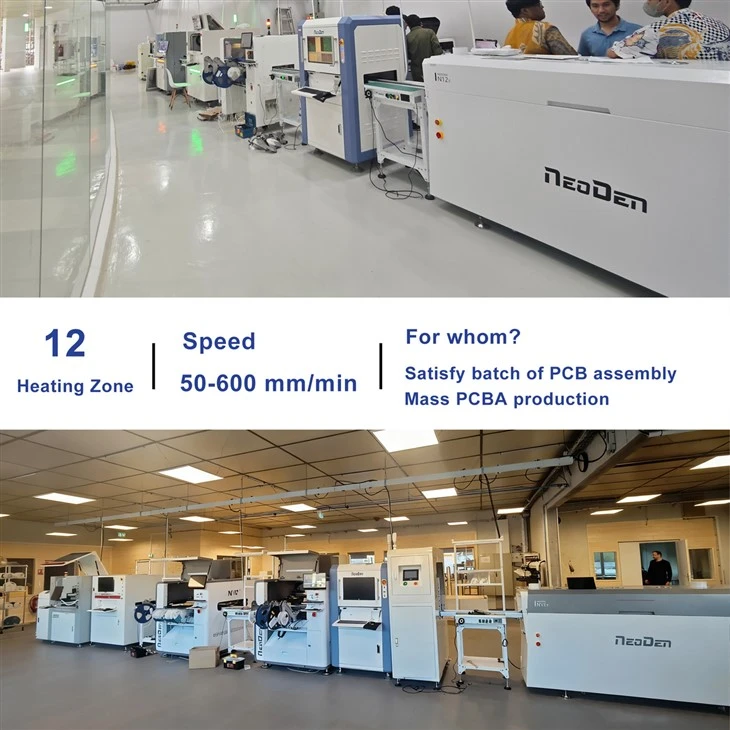
3. NeoDen IN12C Reflow Soldering Solution
The NeoDen IN12C is an intelligent reflow soldering machine designed to meet the demands of modern SMT production, delivering a stable PCB soldering process through a precise temperature control system.
Suitable for:
- High-density PCBs
- Precision electronic products
- Small- to medium-volume SMT production
A. 12-Zone Design for Precise Temperature Control
The IN12C features 12 independent temperature control zones, allowing for more precise adjustment of:
- Preheating curves
- Hold time
- Reflow peak temperature
- Cooling rate
B. Intelligent PID Temperature Control System for Improved Soldering Stability
The IN12C employs intelligent temperature control technology, using high-precision sensors to monitor temperature changes inside the oven in real time.
Advantages include:
- Rapid temperature rise response
- Stable temperature maintenance
- Reduced temperature deviation
Helping manufacturers maintain consistent soldering quality.
C. Efficient Hot Air Circulation for Improved Soldering Uniformity
Reflow soldering requires not only reaching the set temperature but, more importantly, ensuring consistent heat distribution across different areas of the PCB.
The IN12C improves heat distribution within the oven through its hot air circulation system, ensuring that:
- Large components
- Small chips
- Densely populated areas
all achieve stable soldering results.