

Introduction
As electronic products continue to evolve toward miniaturization, high density, and high reliability, an increasing number of electronics manufacturers are establishing their own fully automated SMT production lines.
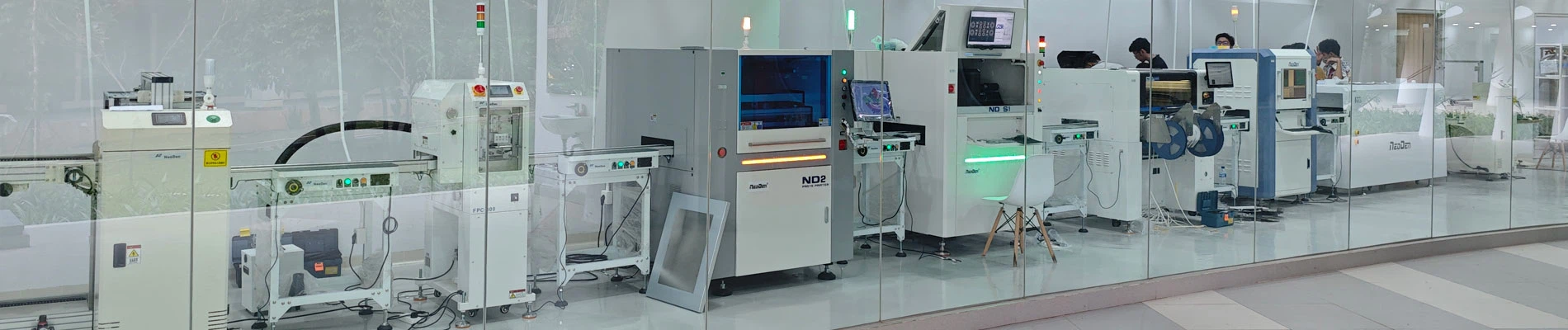
This article will provide a detailed overview of the core equipment required for a complete SMT automated production line. By integrating NeoDen's SMT solutions, it aims to help electronics manufacturers understand how to build a PCB assembly production line tailored to their specific needs.
A standard SMT automated production process typically includes:
Solder paste printing → SPI → Component placement by a pick-and-place machine → Reflow soldering → AOI → X-ray inspection → PCB conveyance and buffering

Step 5: Automatic Optical Inspection Machine
1. Why does an SMT production line need AOI inspection?
After solder paste printing, component placement, and reflow soldering, the PCB assembly process is essentially complete. However, various assembly defects may still occur during production, such as:
- Missing components
- Incorrectly placed components
- Incorrect component polarity
- Component misalignment
- Solder bridges
- Soldering defects
If these issues are not detected in a timely manner, they may lead to:
- Increased product rework costs
- Batch-wide quality issues
- Customer complaints
- Delays in production and delivery
Therefore, AOI has become a critical quality control device in modern automated SMT production lines.
2. The Role of AOI in the SMT Production Process
Typically, AOI equipment can be deployed at multiple locations:
a. Post-screening AOI inspection
Primarily used to inspect:
- PCB pad condition
- Solder paste printing anomalies
- PCB contamination issues
This helps companies detect solder paste printing defects early on.
b. Post-placement AOI inspection
Primarily checks:
- Whether components are correctly installed
- Whether component positioning is accurate
- Whether component orientation is correct
This prevents errors from proceeding to the reflow soldering stage.
c. Post-Reflow AOI Inspection
This is currently the most common application.
Primarily inspects:
- Solder joint quality
- Missing components
- Soldering anomalies
- Component misalignment
It helps companies establish a final quality control stage.
3. What Are the Advantages of AOI Inspection Over Manual Visual Inspection?
Traditional manual inspection has the following limitations:
- Slow inspection speed
- Significant variations in subjective judgment
- Prone to fatigue during prolonged work
- Difficulty in detecting minute defects
In contrast, automated optical inspection (AOI) equipment, utilizing high-definition industrial cameras and intelligent algorithms, can achieve:
- High-efficiency inspection: Rapidly scans the entire PCB, improving production throughput.
- High consistency in inspection: Eliminates judgment discrepancies among different operators.
- Data-driven quality management: Saves inspection results to provide data support for production analysis.
For mass-production enterprises, AOI is not merely an inspection device but a quality management tool that enhances production stability.
4. NeoDen ND800 AOI Automatic Optical Inspection Solution
The NeoDen ND800 AOI is an automatic optical inspection system designed for SMT production lines, helping electronics manufacturers quickly identify quality issues during the PCB assembly process.
The system captures PCB images via its vision system and performs automatic analysis using software algorithms.
Key inspection items include:
- Component placement status
- Component positional deviation
- Missing components
- Solder joint defects
Suitable for:
- PCBA factories
- EMS manufacturers
- Industrial electronics production
- Manufacturing of high-reliability electronic products
Step 6: SMT X-Ray Inspection Equipment
1. Why Can't AOI Completely Replace X-Ray Inspection?
As electronic products continue to shrink in size, high-density packaging technologies are becoming increasingly common.
For example:
- BGA (Ball Grid Array)
- CSP (Chip Scale Package)
- QFN (Quad Flat No-lead Package)
The solder joints for these components are located on the underside of the device.
While AOI can detect defects on the PCB surface, it cannot directly inspect hidden areas.
For example:
A BGA component may appear to be properly mounted, but internally it may have:
- Missing solder balls
- Cold solder joints
- Voids
- Abnormal solder connections
These issues can only be accurately detected through X-ray inspection.
2. The Value of X-Ray Inspection in High-Reliability SMT Manufacturing
X-ray equipment uses X-rays to penetrate PCBs and electronic components, creating internal images based on the varying degrees to which different materials absorb the rays.
This allows for the analysis of:
- Hidden solder joint quality
- Internal component structure
- Solder joint integrity
- Potential reliability risks
This is particularly important for the following industries:
- Automotive electronics
- Medical devices
- Industrial control
- Telecommunications equipment
- High-end consumer electronics
3. NeoDen ND56X X-Ray Inspection Equipment Solution
The NeoDen ND56X is a compact, precision microfocus X-ray inspection system suitable for quality inspection applications in R&D companies, laboratories, and electronics manufacturing facilities.
Compared to large-scale industrial X-ray systems, the ND56X offers the following features:
- Compact size
- Simple operation
- Easy installation
- Suitable for precision electronic inspection
and other features.
a. High-Resolution Microfocus X-Ray Imaging
The ND56X features a microfocus X-ray tube design:
- Voltage range: 40–90 kV
- Current range: 10–200 μA
- Maximum output power: 8 W
- Microfocus spot size: 15 μm
Paired with an industrial dynamic FPD detector, it can quickly capture high-definition inspection images.
This enables it to meet the application requirements of precision chip inspection, BGA solder joint analysis, and SMT packaging quality inspection.
b. Supports inspection of complex packaging such as BGA and CSP
The ND56X is suitable for inspection in the following areas:
- Chips
- BGA/CSP
- Wafers
- SOP/QFN
- SMT-packaged products
and other fields.
For PCB products utilizing advanced packaging technologies, the ND56X helps engineers identify issues that traditional vision inspection cannot detect.
c. Multi-angle inspection to enhance defect analysis capabilities
Due to their structural characteristics, the internal condition of certain specialized components cannot be accurately assessed from a single angle.
The ND56X supports:
- ±30° tilt angle inspection
- 360° rotational inspection
Engineers can observe internal structures from different angles, improving the accuracy of defect analysis.
d. Automated Inspection and Data Management
The ND56X supports:
- CNC multi-point automated inspection
- Automatic saving of inspection images
- Automatic generation of inspection reports
- Batch inspection
This helps companies establish more standardized quality analysis processes.
Step 7: SMT Conveyors and Buffer Systems
1. Why Does a Complete SMT Production Line Still Require Auxiliary Equipment?
Many companies tend to overlook the importance of conveying equipment when planning an SMT production line. In reality, an automated SMT production line requires not only core equipment but also automated connections between devices.
Without a well-designed PCB conveying system, the following issues may arise:
- Increased manual handling
- Unstable production cycle times
- Increased equipment wait times
- Reduced automation levels
2. Primary Functions of SMT Conveyors and Buffer Systems
a. Automatic PCB Conveyance
Reduces manual intervention and improves production continuity.
b. Balancing Equipment Cycle Times
Different pieces of equipment operate at varying speeds.
For example:
Placement machines are fast, but reflow soldering requires a fixed amount of time.
Buffers can temporarily store PCBs, preventing the entire line from coming to a halt.
c. Enhancing Production Scalability
When adding SPI, AOI, X-ray, or new placement machines in the future, it becomes easier to upgrade the production line.
Why Choose NeoDen to Build a Complete SMT Production Line?
From individual machines to a complete PCB assembly solution. For many electronics manufacturers, purchasing SMT equipment is not merely about acquiring machines; more importantly, it is about establishing a stable and efficient production system.
Advantages of NeoDen's SMT Solutions:
- Covers the entire SMT process: From PCB feeding to final quality inspection, helping customers reduce coordination costs associated with multiple suppliers.
- Meets production needs of various scales, supporting different application scenarios such as PCB R&D, small-batch production, and medium-scale manufacturing.
- Provides professional technical support to help customers plan production line layouts, select appropriate equipment, and optimize production processes.

Conclusion
A complete automated SMT production line is not merely a simple combination of several pieces of equipment, but rather a smart manufacturing system built around efficiency, precision, stability, and quality control-where every step impacts the final PCB product quality.
For companies seeking to increase production capacity, reduce manufacturing costs, and establish in-house PCB assembly capabilities, choosing the right SMT equipment supplier is crucial.
Contact NeoDen today to get your customized SMT automation production line solution.