
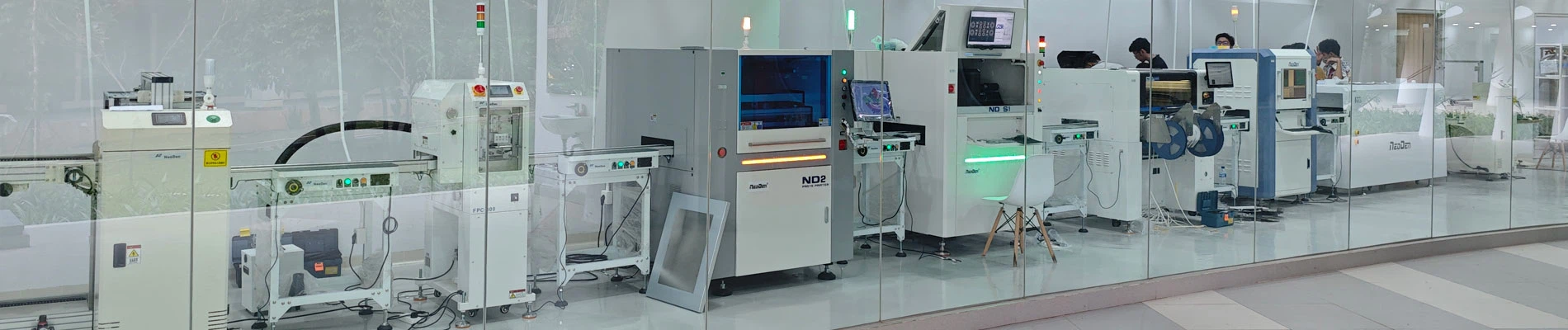
There are many types of wave soldering machines. However, the basic components and principles of these machines are the same. The basic equipment used in the process is a conveyor belt that moves the printed circuit board through different areas, a solder tray used in the soldering process, a pump that produces the actual waves, a flux sprayer and a preheat pad. The solder is usually a metal mixture.
Flux
Flux in the wave soldering process has a primary and a secondary objective. The primary objective is to clean the parts to be soldered, primarily any oxide layer that may have formed. There are two types of fluxes, corrosive and non-corrosive. Non-corrosive fluxes require pre-cleaning and are used when low acidity is required. Corrosive fluxes are fast and require little pre-cleaning, but have a higher acidity level.
Preheating
Preheating helps speed up the soldering process and prevents thermal shock.
Cleaning
Some types of fluxes, called "no-clean" fluxes, do not require cleaning. Their residues are harmless after the soldering process. Often, no-clean fluxes are particularly sensitive to process conditions, which may make them undesirable in some applications. However, other types of fluxes require a cleaning stage where the PCB is washed with solvents and/or deionized water to remove flux residues.
Finish and quality
Quality depends on the proper temperature when heated and the properly treated surface.
Types of Solder
Different combinations of tin, lead and other metals are used to make solder. The combination used depends on the desired properties. The most popular combinations are the SAC (tin (Sn)/silver (Ag)/copper (Cu)) alloy for lead-free processes and Sn63Pb37 (Sn63A), a eutectic alloy consisting of 63% tin and 37% lead. The latter combination has high strength, a small melting range, and fast melting and solidification (i.e., there is no "plastic" range between the solid and molten states as in the older 60% Sn/40% Pb alloy). Higher tin compositions give the solder higher corrosion resistance, but raise the melting point. Another common composition is 11% tin, 37% lead, 42% bismuth, and 10% cadmium. This combination has a lower melting point and is useful for soldering heat-sensitive parts. Environmental and performance requirements also factor into the choice of alloy. Common limitations include lead (Pb) when RoHS compliance is required, and pure tin (Sn) when long-term reliability is a concern.
Effect of cooling rate
It is important to allow PCBs to cool at a reasonable rate. If they cool too quickly, then the PCB may become distorted and the solder will be affected. On the other hand, if the PCBs are allowed to cool too slowly, then the PCBs will become brittle and some components may be thermally damaged. PCBs should be cooled with a fine water spray or air cooling to reduce the level of damage to the board.
Thermal Profiling
Thermal profiling is the measurement of several points on a circuit board to determine its thermal excursion during the soldering process. In electronics manufacturing, SPC (Statistical Process Control) helps determine if the process is under control by measuring the reflow parameters as defined by the soldering technique and component requirements.
Solder wave height
The height of the solder wave is a key parameter to evaluate when setting up a wave soldering process. The contact time between the wave and the component to be welded is usually set at 2 to 4 seconds. This contact time is controlled by two parameters on the machine, the conveyor speed and the wave height, and a change in either of these two parameters will result in a change in the contact time. Wave height is usually controlled by increasing or decreasing the pump speed on the machine. If more detailed documentation is required, a fixture that digitally records contact time, height and speed can be used to evaluate and check changes. In addition, some wave soldering machines allow the operator to choose between a smooth laminar wave or a slightly higher pressure "dancing" wave.
