
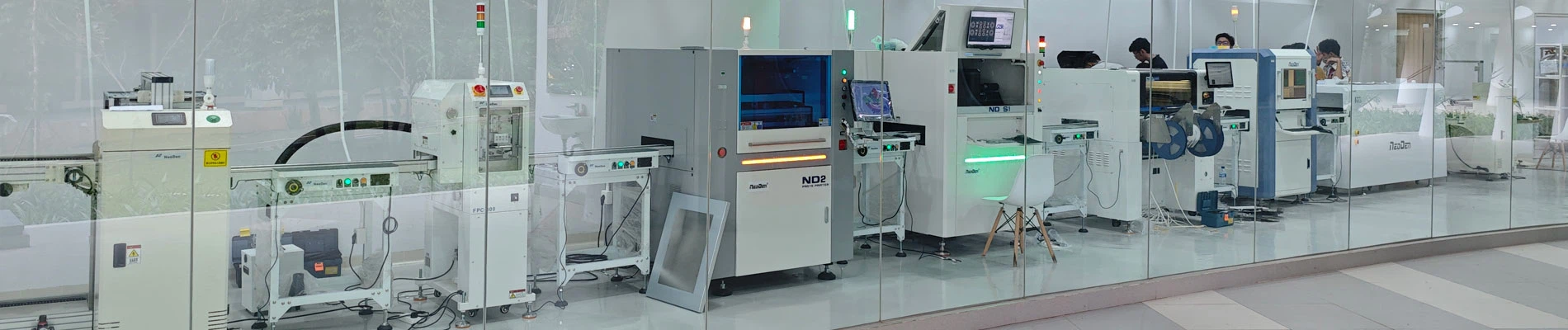
Reflow oven is the soft soldering of mechanical and electrical connections between the solder ends or pins of surface assembly components and the PCB pad by remelting soft paste solder material preassigned to the PCB pad.
SMD welding is achieved by the physical reaction of the gelatinized flux under a certain high temperature airflow by relying on the action of hot air on the solder joint.
Heating zone, Heat preservation zone, welding zone, cooling zone.
1. When PCB enters the heating zone, the solvent and gas in the solder paste evaporate. At the same time, the flux in the solder paste wets the pad, the ends and pins of the component, and the solder paste softens and collapses, covering the pad, isolating the pad, the pins of the component and oxygen.
2. PCB enters the heat preservation zone, so that PCB and components are fully preheated, in case PCB suddenly enters the welding high temperature area and damages PCB and components.
3. When PCB enters the welding zone, the temperature rises rapidly so that the solder paste reaches the melting state, and the liquid solder wets the PCB pad, component ends and pins, and diffuses, diffuses or backflows to form solder contacts.
4. PCB enters the cooling area to solidify the solder joint and complete the whole reflow welding process.
In SMT reflow oven soldering process, there are three main reasons for the uneven heating of reflow components: the difference of the heat capacity or absorption of reflow components, the influence of conveyor belt or heater edge, and the load of reflow products.
1. Generally, PLCC and QFP have higher heat capacity than a discrete sheet component, so it is more difficult to weld large area component than small component.
2. In the reflow welding furnace, the conveyor belt in the reflow welding of the product, but also become a heat dissipation system, in addition to the heating part of the edge and the center of the heat dissipation conditions are different, the edge temperature is generally low, in addition to the temperature requirements of each temperature zone in the furnace, the same load surface temperature is also different.
3. Different effects of product loading. The temperature curve of reflow welding should be adjusted to obtain good repeatability under no load, load and different load factors. Load factor is defined as LF=L/(L+S); Where L= the length of the assembled substrates, S= the interval between the assembled substrates.
The higher the load factor, the more difficult it is to get good repeatability. Normally the maximum load factor of reflow furnace is 0.5~0.9. This depends on the product situation (component welding density, different substrate) and the different type of reflow furnace. Practical experience is important to achieve good welding results and repeatability.
