
Introduction
When establishing a new SMT production line, many engineers, managers, and even procurement teams face numerous challenges. Whether it's building a new factory, expanding production lines, or upgrading existing equipment, a clear and systematic checklist is key to ensuring efficiency, quality, and scalability.
This article provides a comprehensive SMT production line setup checklist, covering the entire process from preliminary planning, layout design, equipment selection, integration and debugging to final commissioning. This guide is suitable for all companies currently setting up or planning to set up an SMT production line.

Step 1: Define Manufacturing Requirements
Before selecting equipment, clearly define the objectives the SMT production line needs to achieve:
- Product Type: What types of PCBs will you produce? For example, consumer electronics, automotive electronics, or industrial control boards
- Production Volume and Batch Size: Are you targeting high-volume standardized production or flexible production of multiple varieties in small batches?
- Component Type: Does the production involve high-density fine-pitch components, BGAs, QFNs, or ultra-small 0201 passive components?
This step forms the foundation for all subsequent decisions, ensuring that every investment aligns with your business and technical objectives.
Step 2: Plan the factory layout
A well-designed layout directly impacts production line efficiency, cycle time, and maintenance convenience.
Key considerations
- Space allocation: Ensure sufficient space is reserved for equipment, operators, material handling, and future expansion
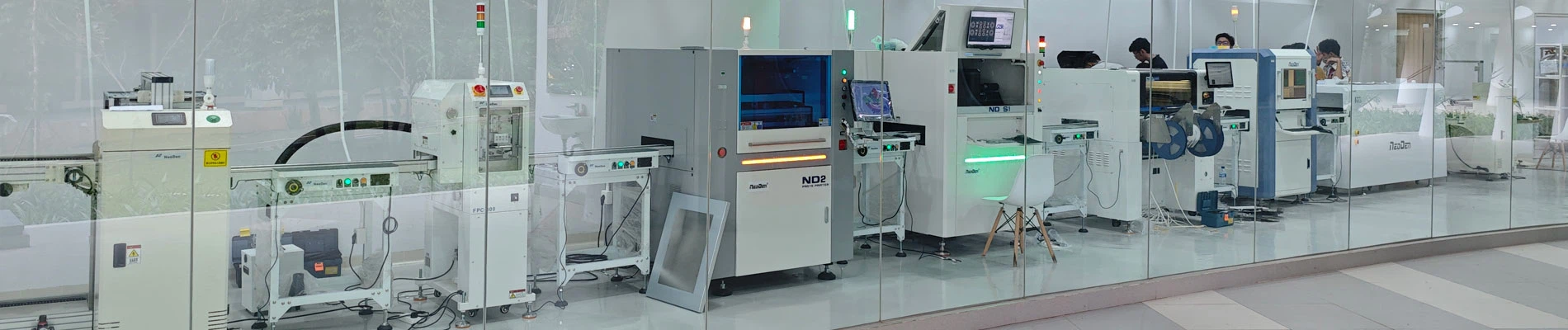
- Process sequence: Typically arranged as: solder paste printer → SMT SPI inspection machine → pick and place machine → reflow oven → SMT AOI inspection machine→ rework station
- Ergonomics and safety: Set up operating areas, emergency stop buttons, and safety passages
- Environmental control: Maintain appropriate temperature and humidity, and implement anti-static measures
It is recommended to use software such as AutoCAD or SolidWorks for layout simulation, and implement only after confirmation.

Step 3: Selecting Appropriate Equipment
Equipment selection directly determines production line yield and capacity.
Core equipment list
| Equipment | Function | Selection Recommendations |
| Screen Printer | Precisely prints solder paste onto PCB pads | Select models with vacuum suction and automatic squeegee pressure adjustment features |
| SPI Machine | Inspects solder paste printing quality | Recommend using 3D SPI for higher precision |
| Pick and Place Machine | Precisely places components onto PCBs | Choose medium-speed or high-speed SMT machines based on requirements |
| Reflow Oven | Melt solder paste to form solder joints | Prioritize the number of heating zones and cooling capacity |
| AOI Machine | Inspect defects after placement | Choose pre-reflow AOI, post-reflow AOI, or a combination of both |
| Conveyor System | Facilitate PCB transfer between workstations | Modular conveyors offer greater flexibility, while fixed conveyors are more cost-effective |
Step 4: Ensure seamless equipment integration
Even if equipment performance is excellent, mismatched interfaces can significantly reduce overall efficiency.
Integration best practices
- Unified interface standards: Adopt the SMEMA protocol to ensure conveyor belt interface compatibility
- Centralized control system: Connect all equipment to a central control system or MES platform for data collection and monitoring
- Power and data cabling: Plan power supply, air supply, and network lines in advance
- Software compatibility: Ensure that the equipment supports common file formats (such as Gerber, CAD, CSV)
During the installation and commissioning phase, work closely with the supplier to ensure stable system operation.
Step 5: Process validation and calibration
After the equipment is installed, each process step must be validated to ensure repeatability and product quality.
Key points for process validation
- Solder paste printing: Use SPI inspection to verify that solder paste volume and position meet requirements
- Component placement accuracy: Run test boards and use reference points to detect placement errors
- Reflow soldering curve: Use thermocouples to measure furnace temperature and adjust parameters to achieve optimal soldering results
- AOI programming: Train the AOI system to recognize correct component positions and acceptable deviation ranges
It is recommended to first run a pilot production batch, collect data, and then proceed with full-scale production.
Step 6: Train operators
- Equipment operation: Operators must master skills such as program loading, nozzle replacement, and troubleshooting
- Maintenance and upkeep: Technicians should understand how to clean stencils, lubricate moving parts, and replace consumables
- Quality management: Quality inspectors must be able to interpret AOI/SPI reports and analyze defect trends
It is recommended to arrange training courses that combine theory and practical exercises.
Step 7: Establish a quality monitoring system
To maintain stable output, a real-time monitoring mechanism must be established.
Recommended Tools
- SPC: Monitor critical metrics such as solder paste volume and placement accuracy
- MES: Track work-in-progress status, traceability, and OEE (Overall Equipment Effectiveness)
- Error-Proofing Mechanisms: Use barcode scanning and automatic program switching to reduce human errors
These systems help identify anomalies early and drive continuous improvement.
Step 8: Develop a Maintenance and Technical Support Plan
Regular maintenance can effectively reduce downtime and extend equipment lifespan.
Maintenance Schedule:
| Item | Frequency | Notes |
| Clean the stencil printer | Daily | Prevent blockages that affect print quality |
| Lubricate the placement head | Weekly | Reduce wear and improve placement accuracy |
| Calibrate the AOI camera | Monthly | Ensure accurate defect detection |
| Inspect the reflow oven thermocouple | Quarterly | Maintain temperature curve consistency |
It is recommended to stock common spare parts and sign maintenance agreements with reliable suppliers.
Step 9: Material Management and Warehouse Configuration
Efficient material flow can significantly reduce bottlenecks and improve overall efficiency.
Best Practices
- Use a kanban system or ERP integration to track materials
- Store sensitive components (such as moisture-sensitive ICs) in a dry cabinet
- Clearly label material rolls and use barcode scanners to record incoming and outgoing materials
- Introduce automatic Feeder Changer or intelligent feeding systems where feasible
Effective inventory management prevents production downtime due to material shortages.
Step 10: Formal Launch and Continuous Optimization
After completing the above steps, the SMT production line can be officially launched.
1. Pre-launch checklist
- All equipment has been tested and is operating normally
- Process validation has been passed, and yield rates meet standards
- Operators have received training
- Quality and safety measures are in place
- MES/SPC system has started collecting data
2. Post-launch optimization
- Analyze OEE data to identify issues
- Conduct lean improvement activities
- Update process flows based on feedback
Conclusion
Building a new SMT production line is a complex system engineering project, but with this ultimate checklist, you will be able to minimize risks, accelerate startup speed, and lay a solid foundation for long-term success.


Frequently Asked Questions
Q1: Should AOI be placed before or after reflow soldering machine?
A: It is recommended to configure both pre-reflow AOI (to detect placement misalignment) and post-reflow AOI (to detect soldering defects), but most companies can initially set up only post-reflow AOI.
Q2: How to choose between modular conveyor belts and fixed conveyor belts?
A: For flexibility and scalability, choose a modular conveyor belt. For limited budgets and stable requirements, a fixed conveyor belt is suitable.
Q3: Is SPI machine necessary?
A: For applications requiring high reliability or high yield rates, SPI is essential for early detection of solder paste defects and reducing scrap rates.