
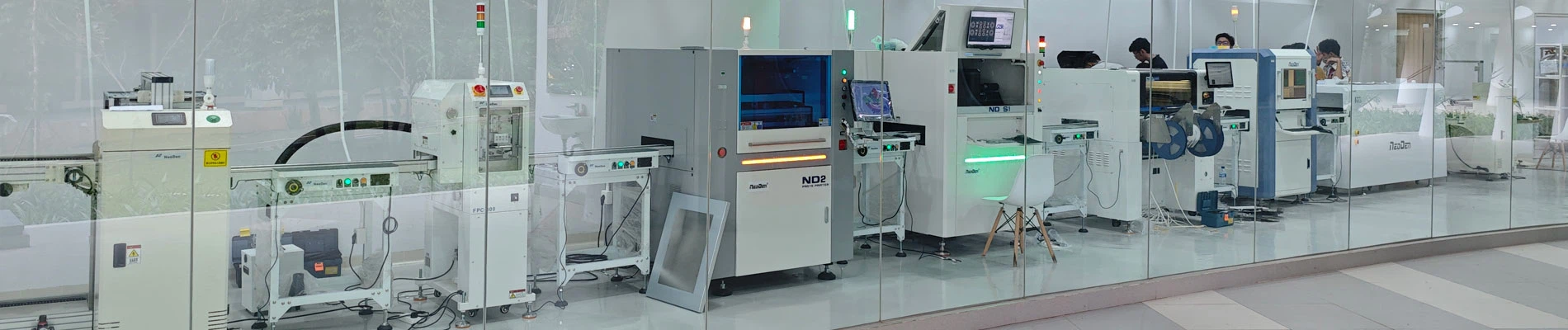
AOI machine working principle and general process of inspection is the same, all through the graphic recognition method. That is, the standard digitized image stored in the AOI system is compared with the actual detected image to obtain the detection results. For example, when detecting a welded joint, a standard digitized image is created according to an intact welded joint, compared with the actual image, and the result of the inspection is passed or failed, depending on the standard image, the resolution and the inspection procedure used. Various algorithms are used in graphic recognition, such as finding the ratio of black to white, color, synthesis, averaging, summing, differencing, planarization, and edge corners.
The light irradiation of AOI has two types of equipment: white light and color light. White light is used with 256 levels of grayscale, and color is used with red, green, and blue light. The light is irradiated to the surface of the solder/component, and the light is reflected to the lens afterward, producing a three-dimensional display of a two-dimensional image to reflect the height and color difference of the solder joint/component. People see and recognize objects by the amount of light reflected back to the judgment, the amount of reflection is bright, the amount of reflection is dark, AOI and human judgment of the same principle.
AOI from the number of lenses, divided into a single lens and multiple lenses, which is only a choice of technical solutions to achieve, it is difficult to say that way is necessarily good, because a single lens through a number of different angles of the light source can also get a very good detection of the image. Especially for lead-free soldering surface is relatively rough, will produce different shapes of solder joints, easy to form bubbles, and prone to warping of one end of the parts, the new AOI inspection equipment are also adapted to the hardware and algorithms of the update.
Current PCB AOI inspection algorithms are probably divided into 3 categories
1. Design rule-based detection algorithms
2. Based on image processing detection algorithms
3. The combination of the above two
AOI report shortcomings in the logic of two kinds: design specifications (DRC) and motherboard (CAM reference) comparison.
Design specification
AOI judges according to the parameters you set, and reports any violation of the parameters as shortcomings.
The main types of defects are minimum line widths, minimum spacing, pinholes, and copper slag.
Motherboard Comparison
The AOI compares the master data learned from CAM data with the actual scanned image and reports any defects that are not within the tolerance range.
These defects are mainly open circuits, short circuits, pads, and pinholes.
The organic combination of design specification and motherboard comparison makes it possible to report only the shortcomings you want to find out and minimize the number of false points.

Features Of NeoDen ND800 SMT AOI Machine
Test mode
Optimized detection technology covering the whole circuit board. Jointed board and multiple marks, with Bad Mark function.
Detection type
Component defects such as whether there is solder paste, offset, insufficient solder, excess solder, open circuit and contamination.
mounting defects such as missing part, offset, skewing, tombstone, mounting on side, turnover, wrong parts, damage and reversal, etc.
solder joint defects such as excess solder, insufficient solder, pseudo soldering, and solder bridge, etc.
and PCB defects such as copper foil contaminated, black pad, de-lamination, copper foil missing, and oxidation, etc.
Image recognition
Automatically set the parameters (e.g. shift, polarity, short circuit, etc.) according to different inspection requirements.
SPC statistical function: Record the test data in the whole process and carry out statistics and analysis, and production status and quality analysis can be viewed in any area.
Camera and lighting system
Full-color high-speed digital CCD camera, with resolution of lens of 10, 15, 18 and 20um, three-channel RGB light source.
Driving system
AC servomotor system, precision grinding ball screw.