
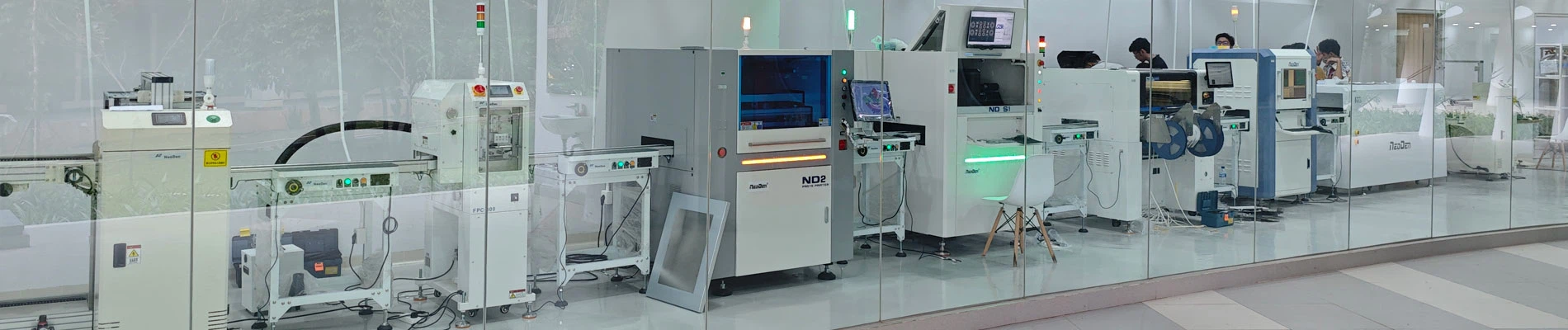
SPI solder paste inspection machine is a device used to inspect the quality of solder joints on circuit boards. It detects the quality of solder joints by using a laser or optical sensor and provides accurate information about the solder joints, such as their position, size and shape.
The working principle of SPI solder paste inspection machine is based on optical or laser technology. In SPI solder paste inspection machine, a laser or LED light source is typically used to illuminate the surface of the circuit board. When the light hits a solder joint, it reflects back and is captured by a receiver. By measuring the intensity and position of the reflected light, the location and size of the solder joint can be determined. In addition, some SPI solder paste inspection equipment can assess the quality of a solder joint by measuring its shape and surface quality.
Commonly used SPI solder paste inspection methods include
1. Optical microscope method
Use an optical microscope to observe the solder joints on the surface of the board to determine their size and shape.
This method is suitable for small circuit boards and small-scale production.
2. X-ray fluorescence spectrometry (XRF)
Use X-ray fluorescence spectroscopy to analyze the elemental composition of the circuit board to determine the material and quality of the solder joints.
This method is suitable for large circuit boards and large-scale production.
3. Thermal Imaging Method
Use an infrared thermal imaging camera to observe the solder joints on the surface of the circuit board to determine their temperature distribution.
This method is suitable for the need to check the soldering temperature and thermal impact of the occasion.
4. Acoustic imaging method
Use ultrasonic probes to observe the circuit board surface of the solder joints to determine their depth and quality.
This method is suitable for occasions where the depth and quality of the weld need to be checked.
5. AOD method
This method is used to determine whether the quality of the solder paste meets the standard by calculating the average height and surface area of the solder paste surface.
The advantage of this method is simple and easy to understand, but for the details of the solder paste surface information can not be accurately judged.
6. 3D scanning method
The method is through the use of laser scanning technology on the surface of the solder paste scanning, and then through the digital model to calculate the volume and height distribution of the solder paste.
The advantage of this method is high precision, can accurately determine the details of the solder paste surface information, but the cost of equipment is higher.
7. FFT (Fast Fourier Transform) method
The method is through the image acquisition data Fourier transform processing, to obtain the surface of the solder paste spectral information. By analyzing the spectral information, you can determine whether there are defects on the surface of the solder paste.
The advantage of this method is that it can detect subtle defects, but it cannot accurately determine the details of the solder paste surface.
8. SPC (statistical process control) method
The method is through the production process of solder paste data statistics to determine whether the quality of solder paste meets the standards.
The advantage of this method is the high real-time, can be real-time monitoring of the production process, but for the abnormalities in the production process, can not be accurately judged.

Features of NeoDen S1 SMT SPI machine
1) Idetification system
Feature: 3D raster camera (double is optional)
Operate interface: Graphical programming, easy to operate, Chinese and English system switch over
Interface: 2D AND and 3D truecolor image
MARK: Can choose 2 commom mark point
2) Programe
Support gerber, CAD input, offline and manual program
3) SPC
Offline SPC: Support
SPC Report: Anytime Report
Control Graphic: Volume, area, height, offset
Export content: Excel, image (jpg, bmp)