

Introduction
For hardware startups, research labs, and corporate R&D teams, establishing an in-house desktop SMT production line is a practical strategy for shortening iteration cycles. Engineering teams no longer need to spend days waiting for third-party production schedules. Instead, they can complete the placement and soldering of prototypes within the lab in just a few hours.
This guide explains how to select, configure, and optimize an SMT production line suitable for modern high-mix, low-volume prototyping.
What Is a Desktop-Scale SMT Production Line?
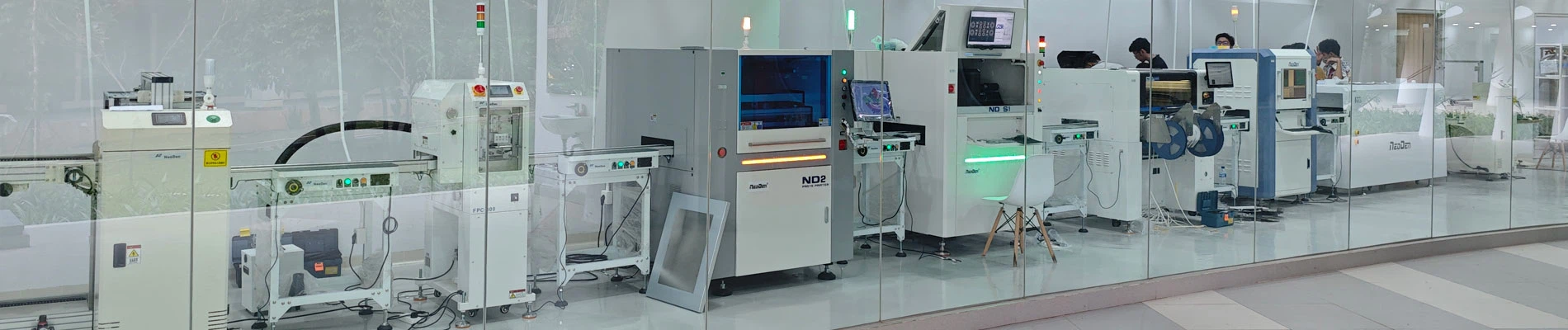
A desktop-scale SMT production line is an integrated system of compact, desktop-sized electronic assembly machines designed to operate within office, laboratory, or prototyping workshop environments. Unlike full-scale industrial SMT lines, which require extensive floor space, three-phase electrical infrastructure, and industrial exhaust systems, desktop configurations can operate from a standard single-phase wall outlet while still providing the mechanical precision required for modern surface-mount components.
A practical prototype production line relies on three standard process stages:
[ Solder Paste Printer ] ──> [ Desktop Pick and Place Machine ] ──> [ Desktop Reflow Oven ]
(Apply solder paste) ──> (Place components) ──> (Bake and solder)
By connecting these three devices, engineering teams can transform bulk components and bare boards into fully soldered finished boards without ever leaving the lab.
Why Engineering Teams Choose to Bring PCB Assembly In-House
- Shorten development cycles: Typical outsourced rapid prototyping assembly usually takes 3 to 10 business days. With an in-house desktop line, engineers can complete the entire process-from modifying traces, printing solder paste, and placing components to finishing the reflow-in less than three hours.
- Lower per-run costs: External prototyping factories charge substantial non-recurring engineering (NRE) fees, stencil tooling costs, and machine programming fees to offset their setup downtime on low-volume orders. In-house assembly strictly limits your per-run costs to the bare PCB and the components on the bill of materials (BOM) themselves.
- Design and inventory flexibility: If a critical integrated circuit (IC) becomes unavailable due to delivery issues, engineers can immediately modify the package or directly substitute an alternative component, thereby avoiding the processes and delays associated with coordinating formal engineering change orders (ECOs) with external suppliers.
- Intellectual Property Protection: For defense contractors, medical device startups, and hardware developers with core patents, keeping physical prototypes within secure in-house facilities completely eliminates the security risks associated with sending CAD files and design documents to third parties.

NeoDen Desktop-Level Prototyping Solution Recommendations
When selecting specific equipment, the market often faces a dilemma between "the bulk and high cost of industrial-grade equipment" and "the low precision and instability of hobbyist-grade equipment." To address the comprehensive requirements of modern R&D laboratories in 2026 for cost-effectiveness, high precision, and compact footprint, the following classic desktop equipment suite developed by NeoDen represents a widely validated, practical closed-loop solution in the industry.
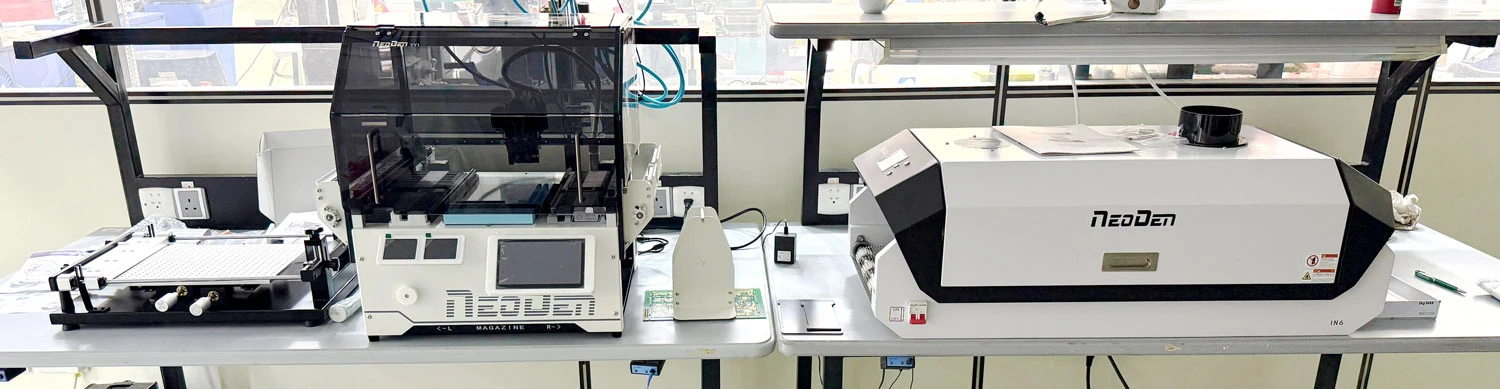
1. Solder Paste Printing Stage: NeoDen FP2636 Frameless Stencil Printer
Printing is the foundation of the entire SMT process, with over 60% of soldering defects stemming from improper printing. NeoDen FP2636 is a desktop frameless stencil printer specifically developed for prototype production.
- Process Highlights: It employs a bidirectional T-bar screw adjustment mechanism, combined with X/Y/Z and angle adjustment handles, to achieve extremely high-precision alignment between the stencil and PCB pads.
- Practical Value: Traditional framed stencils are not only expensive to produce but also take up a significant amount of storage space. The FP2636's frameless quick-lock structure allows engineers to purchase low-cost frameless sheet stencils directly, with installation and tensioning completed in minutes, significantly reducing non-recurring engineering (NRE) costs for single-prototype runs. Equipped with multi-hole positioning pins and PCB support pins, it ensures a flat printing surface even when handling double-sided multilayer boards or thin, lightweight boards.
2. Component Placement Stage: NeoDen YY1 Automatic SMT Placement Machine
As the core of the entire production line, the placement machine determines the minimum component size and placement reliability. NeoDen YY1 is an automatic desktop placement machine that seamlessly integrates an industrial-grade vision alignment system into a compact footprint.
- Process Highlights: The machine is equipped with a dual-vision integrated control system. The downward-facing camera is used for high-precision mark point positioning and board skew correction; the critical upward-facing high-resolution camera performs real-time optical inspection of picked-up ICs (such as QFN and LQFP) and micro passive components like 0402, automatically correcting angle and pin center deviations before placement.
- Practical Value: Addressing the frequent component changes typical of hardware development, the YY1 has redesigned its control software and feeding ecosystem. It supports one-click import of standard ECAD coordinates (Centroid Data) via CSV format and features an extremely flexible new magnetic tape-stripping feeder architecture that accommodates open-reel tape, IC tubes, and custom bulk trays. Its innovative fully automatic nozzle change function (with 3 nozzle storage slots) and one-click system fault alert icon ("?") ensure high efficiency and low error rates during single-operator use.
3. Reflow Soldering Stage: NeoDen IN6 Full Hot-Air Reflow Oven
After SMT placement, an unstable thermal field can directly lead to tombstoning, cold solder joints, or thermal damage to components. The NeoDen IN6 is a benchtop reflow oven that utilizes full hot-air convection technology.
- Process Highlights: Unlike traditional drawer-type infrared ovens with uneven temperature distribution, the IN6 utilizes an internal micro-circulation air duct to forcefully and uniformly heat the air throughout the chamber. It supports high-precision multi-zone programming control, allowing engineers to precisely adjust the "preheating-wetting-reflow-cooling" temperature profiles for leaded, lead-free (e.g., SAC305), and various complex PCBs.
- Practical Value: The IN6 features built-in high-sensitivity temperature sensors and precise chain conveyor control, effectively mitigating the "thermal shadow" effect caused by uneven PCB copper foil thickness or large-volume components (such as large inductors or shielding covers). Additionally, to meet environmental requirements in office or standard R&D laboratories, the IN6 comes standard with a built-in solder fume filtration system. This efficiently filters and purifies heat-activated flux fumes without the need for additional exhaust ducts to the outside, ensuring air safety in the workplace.
Cost Analysis and Return on Investment (ROI)
The following is a realistic financial estimate for establishing this officially recommended prototype production line.
Initial Equipment Capital Expenditure (Precise Configuration Pricing)
- NeoDen FP2636 Frameless Screen Printer: $599
- NeoDen YY1 Automatic Dual-Vision Placement Machine: $2,899
- NeoDen IN6 Full Hot-Air Indoor Recirculating Reflow Oven: $2,399
- Basic consumables and accessories (solder paste refrigerator, stirrer, squeegee, manual inspection microscope): approx. $500
- Total initial capital investment: $6,397
Break-Even Financial Analysis
Assuming a medium-sized hardware team manages 3 independent product designs per year, each design undergoes an average of 4 major hardware revisions before entering the final mass production phase. Each revision cycle requires the assembly of a small-batch validation run consisting of 5 prototype boards.
3 projects × 4 revisions = 12 prototype runs per year
- Outsourcing cost structure: Including engineering setup fees, framed stencil costs, minimum order quantity surcharges, and expedited shipping fees, commercial rapid prototyping assembly services charge an average of $1,500 per prototype run. Total annual outsourcing expenses: $18,000.
- In-house operations structure: Each revision uses third-party rapid laser frameless stencils at approximately $25, plus a small amount of solder paste material costs. Total annual in-house consumables cost: $300.
- Financial summary: By moving assembly in-house, the company can save approximately $17,700 in external service fees annually. Since the total price of the NeoDen production-grade prototyping suite is only $6,397, the initial capital investment can be fully recouped within 4 to 5 months. This means that in less than six months, the investment not only pays for itself but also permanently frees the engineering team from the constraints of external scheduling lead times.
Frequently Asked Questions (FAQ)
1. Can a desktop SMT machine reliably handle BGA and QFN packages?
Answer: Yes. As long as the machine is equipped with a high-resolution, adjustable-light-source top-view camera, it can calculate the center of the BGA ball array and the bottom pads of the QFN, automatically correcting the orientation and alignment angle to within ±0.03mm before placement.
2. Can a standard office or residential power grid meet the power requirements of a desktop SMT line?
Answer: Yes. Unlike industrial-grade factory equipment that requires three-phase power, high-quality prototype desktop equipment-including printers, pick-and-place machines, and desktop reflow ovens-is power-optimized and can be plugged directly into a standard single-phase 110V or 220V wall outlet.
3. What is the operational difference between infrared (IR) reflow ovens and high-power hot-air convection reflow ovens?
Answer: Infrared reflow ovens use direct radiant heat. Since dark-colored or larger components absorb more heat than light-colored or small parts, this can easily lead to uneven heating of solder joints across the board. High-power hot-air convection reflow ovens ensure uniform heat distribution across the entire PCB assembly by circulating air evenly within the chamber.
4. Does operating a benchtop SMT production line require a dedicated cleanroom environment?
Answer: No. Although dust control is helpful for improving solder paste printing quality, benchtop lines can operate perfectly normally in a standard air-conditioned office, a regular laboratory, or a product development lab. During operation, it is recommended that operators wear antistatic clothing to prevent strong static electricity from interfering with the equipment's screens or highly sensitive ICs.
5. How long does it typically take for an engineer to learn how to operate a desktop SMT placement machine?
Answer: Thanks to the intuitive software interfaces of modern placement machines, an electronics engineer or technician can typically master CAD data conversion, feeder programming, and basic machine operation after 2 to 3 days of hands-on practice.
6. Can a desktop SMT line process double-sided SMT circuit boards?
Answer: Yes. The standard process involves first assembling, placing, and reflow soldering the first side, which contains smaller, lighter components. The board is then flipped, solder paste is reapplied to the second side, and components are placed. During the second reflow cycle, the surface tension of the molten solder naturally holds the small, lightweight components on the reverse side in place, preventing them from falling off.

Conclusion
Establishing a desktop-level SMT production line is a practical investment in achieving autonomy in engineering R&D. Eliminating long-term reliance on external rapid prototyping assemblers empowers your team to firmly control the manufacturing process, transforming hardware validation cycles from lengthy, multi-day waits into predictable, same-day closed-loop workflows.
When planning your equipment configuration, prioritize systems that accommodate the smallest component packages you target and the variety and volume of materials you commonly use. By choosing this highly synergistic, safe, and eco-friendly "closed-loop golden prototyping chain"-comprising the NeoDen FP2636 ($599), YY1 ($2,899), and IN6 ($2,399)-the core return on this investment will be tangibly reflected in your most critical metric: time-to-market.