

Introduction
For hardware entrepreneurs, electronics enthusiasts, and R&D departments at small and medium-sized enterprises, PCB prototyping has always been a major challenge. Manually soldering 0402-package components not only tests your eyesight but also wears down your patience. Outsourcing PCBA prototyping, on the other hand, is not only expensive, but the lengthy logistics cycles and communication costs often significantly slow down R&D iteration speeds. Have you ever imagined the efficiency of being able to "modify the design in the morning and ship the product in the afternoon" right in your own studio?
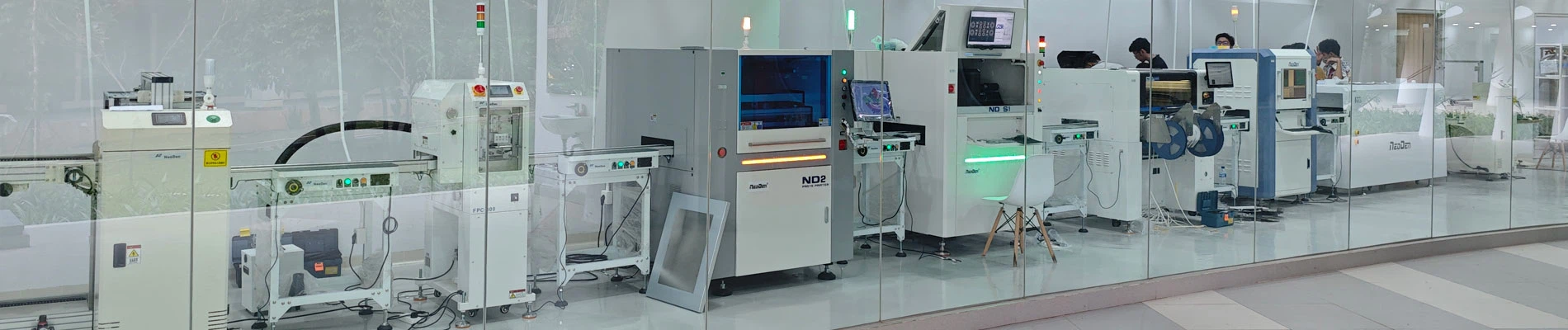
With the advent of the desktop SMT era, this dream has become a reality. Today, we'll delve into how to use the NeoDen YY1 SMT placement machine, paired with the NeoDen FP2636 manual solder printer and the NeoDen IN6 reflow oven-this "desktop production trio"-to build a high-efficiency, professional small-scale PCB factory within a limited space.

Why Choose NeoDen?
Before selecting equipment, brand reliability is crucial. This isn't just about buying a machine, it's about choosing a long-term partner. Since its establishment in 2010, NeoDen Tech has consistently focused on the R&D and manufacturing of small-scale SMT machines, making it a pioneer in the industry that started "small."
- Core Competence: NeoDen operates a modern factory spanning over 27,000 square meters, with three R&D departments and a team of over 25 professional engineers, having secured more than 70 patents to date.
- Global Trust: Our business spans over 130 countries worldwide, serving more than 10,000 satisfied customers. Whether for R&D prototyping or small-to-medium batch production, NeoDen's equipment has been rigorously validated in global markets.
- Hassle-Free After-Sales Support: For studio users, after-sales support is a lifeline. NeoDen employs over 30 quality control and technical support engineers, committing to respond to customers within 8 hours, provide professional solutions within 24 hours, and offer localized support through a network of over 40 global distributors.

Step One: in the SMT Production Line: FP2636 Solder Paste Printing
The NeoDen FP2636 manual printing station is designed specifically for desktop environments, striking the perfect balance between precision and cost.
- Say Goodbye to the "Tape-and-Stick" Era: Traditional manual printing often relies on tape to secure the stencil, making it difficult to guarantee precision. The FP2636 is equipped with X/Y/angle adjustment knobs, allowing users to achieve precise alignment between the stencil and PCB pads through mechanical adjustment.
- A cost- and space-saving tool: It supports "frameless stencil." Compared to traditional framed stencils, frameless stencils not only significantly reduce costs but also save valuable storage space in the workshop.
- Easy to Operate: With a simple and sturdy design, beginners can install the positioning pins and adjust the height by following the manual's steps, producing a perfect solder paste board in just a few minutes. For beginners, this is the first step toward building confidence in SMT.
Step Two: YY1 Placement-Opening the Door to Automation at Low Cost
The NeoDen YY1 is the core of this production line. As an automatic SMT placement machine, it breaks the conventional wisdom that "high precision equals high price."
- Plug-and-play, no computer required: The YY1 features a built-in control system that operates via a touchscreen without the need for an external computer. Simply copy the CSV coordinate file exported from EDA software to an SD card, insert it into the machine, and it will automatically read the data, greatly simplifying the workflow.
- Dual Vision Alignment System: This is the key feature that distinguishes the YY1 from low-end blind placement machines. A downward-facing camera locates the mark points on the PCB to compensate for clamping errors, while an upward-facing camera detects center offset and angle in real-time after component pickup. Whether handling 0402 micro-components or multi-pin chips, it achieves "scalpel-level" precision.
- Automatic Nozzle Change Function: In this price range, the YY1 is uniquely equipped with an automatic nozzle change mechanism. It supports simultaneous operation of both heads and allows for uninterrupted production using up to four different nozzle types, all without manual intervention, significantly improving placement efficiency.
- "Step-by-Step" User Experience: Worried about complicated operations? The YY1's software interface features a "?" help icon on every parameter page. Clicking it provides real-time guidance. This user-friendly design greatly lowers the technical barrier, allowing even beginners to get up to speed quickly.
Step Three: NeoDen IN6 Reflow Soldering Machine-Bringing "Industrial-Grade Quality" to Soldering
The NeoDen IN6 reflow soldering machine is optimized for indoor environments, making it an ideal choice for home workshops.
- True Full Hot-Air Convection: Unlike cheap infrared drawer ovens, the IN6 uses 6-zone full hot-air convection heating with a temperature control accuracy of ±0.2°C. This ensures more uniform heating, effectively reducing the "tombstone" effect caused by uneven heating of components.
- Eco-Friendly and Indoor-Safe: This is one of the IN6's standout features. It features a built-in soldering fume filtration system. For home or office users, this eliminates the need for additional exhaust ducting and removes unpleasant odors, truly enabling eco-friendly production.
- Compact Design: With external dimensions of just 1020 x 507 x 350 mm, it fits easily onto a standard workbench. A dynamic display shows real-time temperature curves, allowing you to watch the PCB take shape perfectly, just like on a factory assembly line.
Space Planning: Two Tables Make a Factory
Many users worry that the equipment takes up too much space, but in reality, this setup is extremely space-efficient.
- Space requirements: The total space needed is less than 5 square meters. The recommended layout is: place the FP2636 in the corner of the table for printing, the YY1 in the center of the table for easy operation, and the IN6 on another table or extension table for soldering.
- Low Environmental Requirements: The entire system runs on standard 220V power and does not require special industrial electricity. The only consideration is to follow the NeoDen YY1 User Manual's recommendation to avoid direct sunlight on the machine to prevent affecting the camera's recognition lifespan; simply maintain a clean environment and wear anti-static clothing.
Is It Worth the Investment?
For small and medium-sized enterprises and R&D teams, return on investment is a core consideration.
- Time Savings: R&D iteration cycles are reduced from 7 days when outsourcing to just 2 hours in-house. This time savings means products can be brought to market faster.
- Cost-Effectiveness: Compared to the cost of 20 batches of outsourced prototyping (including shipping and engineering fees), this "golden combination" quickly pays for itself.
- Quality and Privacy: By maintaining full control over component sourcing and soldering quality, you avoid the risk of component mix-ups associated with outsourcing while safeguarding the confidentiality of your design schematics.
Maintenance and Care: Ensuring Long-Term High Precision
To ensure the long-term operation of a small PCB factory, daily maintenance is essential. Based on the manual, we have summarized the "Three Checks" maintenance method:
- Visual Inspection: Observe the machine's operation for abnormalities, such as tape breaks or placement deviations.
- Auditory Inspection: Listen to the machine's operational sounds to detect any unusual noises.
- Hands-On Inspection: Address minor issues promptly, such as cleaning nozzles or clearing guide rails. Regularly clean the YY1 lens to prevent solder paste contamination and replace the IN6 filter (lifespan of approximately 8 months) to maintain the equipment's high precision.
FAQ
Q: Is this equipment suitable for beginners with absolutely no SMT experience?
A: Absolutely. The equipment is designed with ease of use in mind. The YY1 software includes built-in help guides, the FP2636 features intuitive mechanical adjustments, and the IN6 comes with preset temperature profiles. Combined with NeoDen's technical support, even beginners can get up to speed quickly.
Q: Will using the IN6 reflow oven at home cause smoke issues?
A: No. The IN6 features a built-in smoke filtration system designed specifically for indoor environments, eliminating the need for additional exhaust ducts.
Q: How does NeoDen ensure after-sales service?
A: With over 40 global distributors, we guarantee a response to technical support requests within 8 hours and provide solutions within 24 hours, ensuring worry-free production.
Q: What is the smallest component size that can be placed?
A: The YY1 supports micro-components such as 0201 and 0402, and when paired with the dual-vision system, it enables high-precision placement.
Conclusion
The combination of NeoDen YY1, FP2636, and IN6 strikes the perfect balance between "size," "price," and "professional performance." It brings SMT automation capabilities-once reserved for large-scale factories-right to every maker's workbench. With this solution, every one of your ideas can be turned into a physical product with maximum efficiency.
Take action now-contact us to start your journey toward a mini PCB factory, and let your creativity no longer be limited by production capacity!