
Introduction
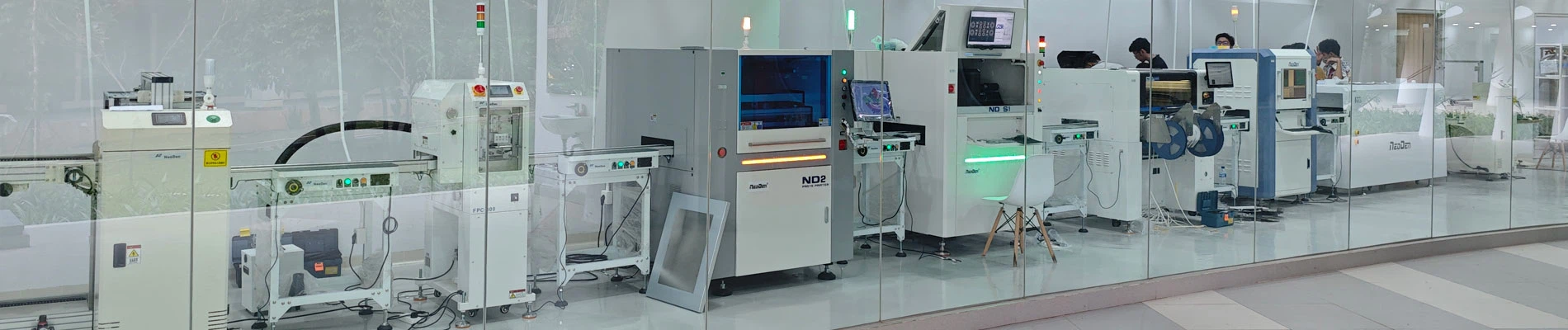
SMT is an assembly technology to solder electronic components directly to the surface of the printed circuit board, which not only improves the density of the components, but also can substantially improve the overall reliability of the board. SMT technology usually uses small electronic components pre-applied with solder, processed by a specific process to achieve fast and efficient assembly. This assembly process has been widely used in modern electronic products.
Fully automated PCB manufacturing line can significantly reduce assembly time and improve overall productivity while maintaining product quality. This allows companies to meet market demand more efficiently, reduce inventory costs, and improve responsiveness.
The introduction of AOI technology is an effective complement to the lack of traditional manual inspection methods. It not only provides higher inspection efficiency and accuracy, but also helps the manufacturing industry to realize automation and digital transformation, providing solid technical support to improve SMT production efficiency. With the continuous progress of technology, SMT AOI equipment will play a greater role in the future production environment.
I. SMT production process overview
1. The basic flow of SMT
- Material preparation: suitable PCBs as well as components.
- Solder Paste Printing: Use screen printing or stencil printer techniques to accurately apply the solder paste on the pads of the PCB.
- Component Mounting: Using a surface mount pick and place machine to accurately place electronic components on the printed solder paste.
- Reflow Soldering: The finished PCB is fed into the solder reflow oven process, where it is heated to melt the solder paste and form a strong connection with the component pins, and then cooled to solidify it.
- Test and inspection: Using SMT AOI equipment or X-ray inspection machine and other technologies to check the quality of the solder joints, detect the existence of short-circuit, open-circuit or false soldering and other problems.

II. Outline of SMT AOI equipment
1. Definition and working principle of AOI
Automatic Optical Inspection, an inspection equipment based on optical principles, is mainly used for quality control in the welding production process. It captures images of welded parts through a high-resolution camera, and then uses image processing technology to compare these images with preset standard templates, so as to accurately detect various types of defects, such as missing components, positional offsets, and standing monuments.
2. Advantages of AOI
- Detection speed: With its high-speed visual processing capabilities, AOI can easily cope with the inspection needs of a large number of circuit boards, greatly enhancing the inspection efficiency.
- Accuracy: AOI can accurately identify all kinds of defects on circuit boards through its sophisticated camera and image processing technology, ensuring the accuracy of the inspection results.
- Cost-effectiveness: Real-time monitoring of the quality of the board on the production line, timely detection and elimination of errors, thereby reducing maintenance costs and circuit board waste, improve manufacturing efficiency and yield rate, and achieve long-term cost savings.
III. The specific role of AOI in improving production efficiency
- Defect detection: AOI system can detect a variety of defects in the PCB surface assembly process, such as missing components, offset, reverse mounting, poor soldering, short circuits, open circuits and so on.
- Improve inspection efficiency: Compared with manual inspection, AOI inspection can complete the inspection of PCB surface assembly quality more quickly, greatly improving the inspection efficiency.
- Reduce human error: AOI system can automatically carry out the inspection, reducing the impact of human factors on the inspection results, thus improving the accuracy and reliability of the inspection and reducing human error.
- Improve product quality: Through timely detection and correction of defects in the surface assembly process, AOI inspection can effectively improve product quality, reduce the defective rate, and ensure product reliability and stability.
- Data analysis and traceability: AOI system can generate detailed inspection reports and image records, data analysis and statistics on the inspection results, to help manufacturers analyze the problems in the production process, quality improvement and traceability.
IV. The implementation of SMT AOI equipment considerations
1. Equipment selection
Manufacturers need to select the appropriate SMT AOI machine based on their production needs, you can evaluate the following dimensions.
- Production requirements: Assess the number of boards produced daily, according to the production volume to choose the appropriate speed and processing capacity of the AOI equipment.
- Product complexity: Consider the complexity and diversity of the product and select an AOI system that can handle a variety of components and soldering processes.
- Inspection accuracy: According to industry standards and product quality requirements, select AOI equipment with high resolution and accuracy to ensure that minute defects can be detected.
- Budget control: Under the premise of meeting the needs, comprehensively consider the procurement cost, maintenance cost and operating cost of the equipment to ensure the cost-effectiveness of the investment.
2. Operation and Maintenance
- Operation training: Provide detailed training for operators, including the basic operation of equipment, daily inspection and troubleshooting. Through training to improve the skill level of employees to ensure the normal operation of the equipment.
- Maintenance Knowledge: Educate employees about the importance of equipment maintenance and perform regular equipment maintenance and calibration to minimize the incidence of malfunctions and extend equipment life.
- Create operation manuals: Develop detailed operation guidelines and maintenance manuals to provide reference for employees and improve the standardization and efficiency of equipment use.
3. Integrate production systems
- System integration: Ensure that SMT AOI machine can be seamlessly connected with other production equipment (e.g., SMT machine, reflow soldering oven) to achieve data sharing and real-time monitoring.
- Process Optimization: Optimize the SMT production process as a whole, so that the AOI inspection process complements the rest of the production line, reducing waiting time and operational errors.
- Data analysis: Use the inspection data collected by AOI equipment to analyze and improve the production line, identify bottlenecks and improve overall production efficiency.
V. Future Outlook
1. The latest development trend of AOI technology
- First, the application of multi-spectral inspection technology, through the ultraviolet, infrared and other multi-band imaging to enhance defect identification capabilities.
- Secondly, the intelligent algorithm is upgraded, and the accuracy of defect classification based on deep learning has exceeded 98%.
- Third, integration with 3D inspection technology, through laser triangulation and other height difference detection.
2. Prospects for the application of artificial intelligence in AOI
With the progress of technology, AI AOI systems will be more intelligent and integrated. Future AOI equipment may combine more perception technologies (e.g., 3D vision, infrared imaging, etc.) and deeply integrate with the Industrial Internet of Things (IIoT) platform to realize a comprehensive smart manufacturing solution. In addition, AI AOI will evolve toward greater real-time performance and flexibility to adapt to rapidly changing market demands.
Conclusion
As the electronics manufacturing industry continues to improve its efficiency and quality requirements, the role of AOI technology in SMT production is becoming more and more important. It not only ensures product quality and reduces production costs, but also accelerates an organization's market response by improving production efficiency. With the further development of the technology, it is expected that AOI will play a more critical role in the field of electronics manufacturing. By accurately deploying AOI technology, companies can not only ensure the production quality of electronic components only, but also take advantage of the competitive market. For electronics manufacturers seeking to improve production quality and efficiency, mastering and applying AOI technology is a critical step forward.

Company profile
Zhejiang NeoDen Technology Co., LTD., founded in 2010, is a professional manufacturer specialized in SMT pick and place machine, reflow oven, stencil printing machine, SMT production line and other SMT Products. We have our own R & D team and own factory, taking advantage of our own rich experienced R&D, well trained production, won great reputation from the world wide customers.
We believe that great people and partners make NeoDen a great company and that our commitment to Innovation, Diversity and Sustainability ensures that SMT automation is accessible to every hobbyist on everywhere.