
Introduction
In the complex and precision-driven field of PCBA manufacturing, product quality is paramount. However, relying solely on final testing to screen out defective products is far from sufficient. An effective quality control system must permeate every stage of the SMT assembly line-from incoming material inspection to finished product shipment-ensuring products meet stringent standards at every step. The core of this system lies in the integration of methodology and technology.

I. Comprehensive Quality Control
Successful quality monitoring aims to prevent defects rather than merely detect them. This requires establishing a monitoring mechanism covering the entire production process.
- Incoming Quality Control (IQC): Before production begins, all components undergo rigorous incoming inspection. This includes verifying specifications, quantity, production dates, and supplier qualifications. Modern factories utilize tools like spectrometers for RoHS compliance testing, ensuring hazardous substances do not enter production.
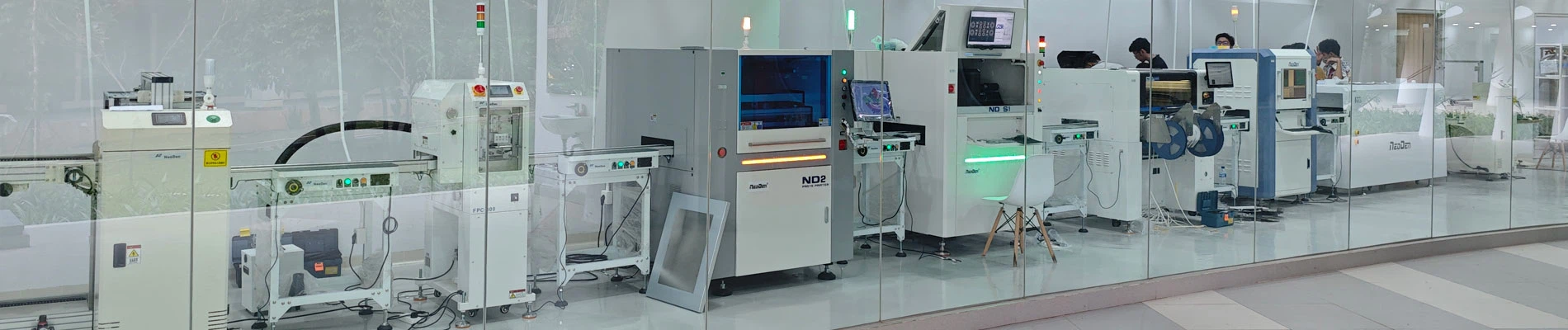
- Pre-Reflow Inspection: This is the first critical checkpoint on the production line. Before component placement, PCBA manufacturers use Solder Paste Inspection (SPI) equipment to precisely measure the volume, height, and shape of solder paste on each pad. Any deviations trigger immediate system alerts, prompting operators to make adjustments and eliminate issues like cold solder joints or short circuits at the source.
- In-line Inspection: After reflow soldering oven, automatic optical inspection (AOI) equipment functions like an unflagging "electronic eye," rapidly and precisely scanning each PCBA. It automatically identifies surface defects such as component misplacement, missing parts, and polarity reversal. For components with bottom-side solder joints like BGAs and QFNs, Automated X-ray Inspection (AXI) equipment is essential. It provides a penetrating view to assess internal solder joint quality-a capability beyond manual inspection or AOI.
II. Data-Driven: From Qualitative Judgment to Quantitative Analysis
Traditional quality management relied on sampling inspections and human expertise, but modern PCBA manufacturing quality control increasingly depends on data. By collecting and analyzing vast amounts of data, companies can achieve real-time monitoring and predictive management of production processes.
- Statistical Process Control (SPC): SPC is a powerful data tool that collects key production parameters (such as reflow oven temperature curves and solder paste print thickness) and plots control charts. When data points exceed predefined control limits, it indicates potential process anomalies. This enables engineers to intervene before issues escalate into batch defects, shifting from "reactive troubleshooting" to "proactive prevention."
- Full Process Traceability: Each PCBA carries a unique ID on the production line, typically a barcode or QR code. This ID acts as an "identity card," recording every stage the board undergoes during production-including material batches used, equipment processed through, and test results. When issues arise, this ID enables rapid root cause tracing to pinpoint whether the problem stems from material defects, equipment failures, or operational errors, facilitating precise troubleshooting and resolution.
III. Continuous Improvement: Establishing a Closed-Loop Feedback Mechanism
The ultimate goal of quality monitoring extends beyond identifying problems; it emphasizes resolving issues and preventing recurrence. This requires an efficient closed-loop feedback mechanism.
- Failure Analysis: When defective products are detected, mere rework is insufficient. These items must be sent to a failure analysis laboratory. Using specialized equipment (such as metallurgical microscopes and scanning electron microscopes), the root cause of failure is analyzed, and a detailed failure report is compiled.
- Design and Process Optimization: Feedback from failure analysis must be shared with design teams and process engineers. For instance, if solder joint failures frequently occur at a specific pad, it may indicate flawed pad design or suboptimal solder paste formulation. This feedback drives design and process enhancements, fundamentally eliminating the issue in future production batches.
Conclusion
Quality control in PCBA manufacturing constitutes a systematic endeavor that integrates advanced automation equipment, data analytics, and continuous improvement principles. Only by organically combining these methodologies can enterprises sustainably deliver high-quality, highly reliable products amidst intense market competition.

Quick facts about NeoDen
1) Established in 2010, 200 + employees, 27000+ Sq.m. factory.
2) NeoDen Products:Different Series PnP machines, NeoDen YY1, NeoDen4, NeoDen5, NeoDen K1830, NeoDen9, NeoDen N10P. Reflow Oven IN Series, as well as complete SMT Line includes all necessary SMT equipment.
3) Successful 10000+ customers across the globe.
4) 40+ Global Agents covered in Asia, Europe, America, Oceania and Africa.
5) R&D Center: 3 R&D departments with 25+ professional R&D engineers.
6) Listed with CE and got 70+ patents.
7) 30+ quality control and technical support engineers, 15+ senior international sales, for timely customer responding within 8 hours, and professional solutions providing within 24 hours.