
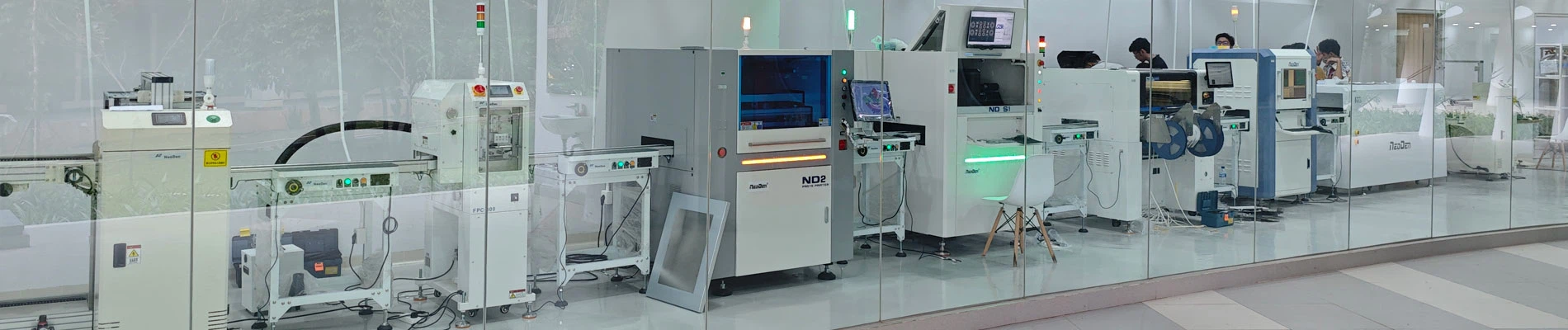
In PCBA processing, SMT production line of the main equipment has a solder paste printer, SMT machine, reflow oven, SMT AOI machine, and most manufacturers will also placed SPI machine after the solder paste printing.
SMT SPI and AOI both PCBA inspection equipment is the use of optical images to check the quality, but SPI is generally placed behind the solder paste printer, mainly to check the amount of solder paste printing, flatness, height, volume, area, whether the height of the deviation, offset, defects, such as breakage.
In the SMT production process, the amount of printed solder paste is related to the reliability and quality of the seams: too much or too little will be transformed into unreliable seams, which has a great impact on the quality of the product and is not allowed. According to industry statistics, in all processes of SMT assembly, 75% of the defects are caused by poor solder paste printing, so the good or bad solder paste printing process largely solves the quality of the SMT process. It can be seen that the application of SPI in the SMT production line process is a very important step.
What is the role of SPI inspection equipment?
1. Reduce defects
Solder paste printing is the first step of the entire patch assembly, and SPI is the first step in the quality control of the PCBA manufacturing process. SPI solder paste inspection equipment was born in order to be able to closely monitor the printing of solder paste in the process of solder paste printing, the use of machines to detect the printing of bad solder paste in this segment, such as insufficient solder paste, too much solder paste, bridge connection, etc.. The realization of the source to intercept the solder paste bad, can avoid bad printing PCB board flow to the next process to continue production and lead to product defects.
2. Improve efficiency
After reflow soldering to check out the defective board, you need to go through the scheduling plan, dismantle the material, wash the board and other processes, at the same time, SMT processing has a lot of 0201, 01005 material, which is a long time for manufacturers to repair work. Then use SPI to detect the defective board in advance of the repair time is much shorter and easier to repair, can be reworked immediately and re-introduced into production, saving a lot of time while improving production efficiency.
3. Cost savings
In the SMT assembly in the early stage, if the use of SPI equipment to detect defective, can be completed in a timely manner to repair, which saves time and cost. On the other hand, to avoid the bad board delayed to the later stages of manufacturing, resulting in poor functionality of the PCBA board, which saves production costs.
4. Improve reliability
As we said earlier, in the SMT chip processing, 75% of the bad is due to poor solder paste printing caused by the SPI can be in the SMT process for the accurate interception of bad solder paste printing, in the source of bad strict control, is conducive to reducing the bad products to improve the reliability.
Nowadays, products tend to be more and more miniaturized, components are also changing, in order to improve the performance while reducing the size, such as 01005, BGA, CCGA, etc. The quality of solder paste printing has higher requirements, so in the SMT process, SPI has been indispensable to a quality control process.

Zhejiang NeoDen Technology Co., LTD., established in 2010 with 100+ employees & 8000+ Sq.m. factory of independent property rights, to ensure the standard management and achieve the most economic effects as well as saving the cost.
Owned the own machining center, skilled assembler, tester and QC engineers, to ensure the strong abilities for NeoDen machines manufacturing, quality and delivery.
40+ global partners covered in Asia, Europe, America, Oceania and Africa, to successfully serve 10000+ users in all of the world, to ensure the better and faster local service and prompt response.
3 different R&D teams with total 25+ professional R&D engineers, to ensure the better and more advanced developments and new innovation.