
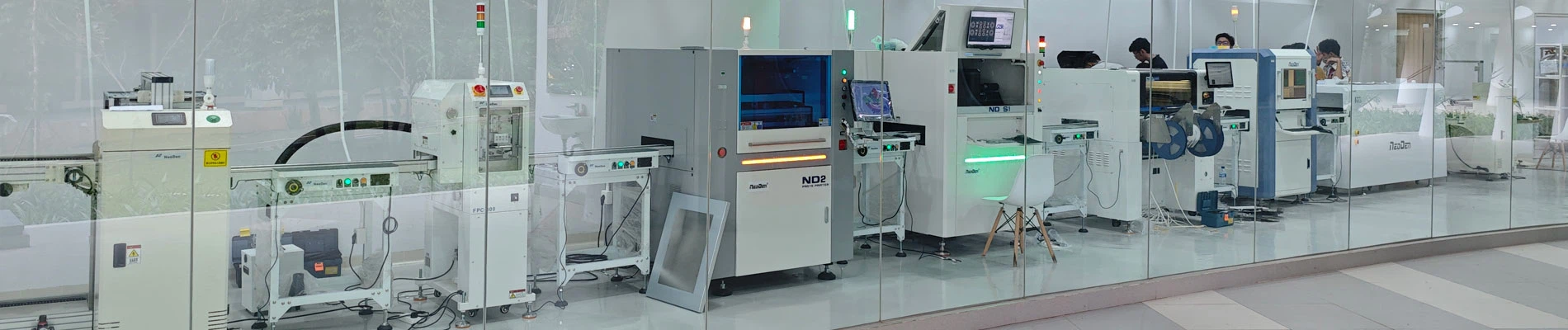
As SMT technology continues to evolve and mature, the emergence of various surface-mount components (SMC) and surface-mount devices (SMD) has driven corresponding advancements in reflow soldering technology and equipment, which are now widely applied across nearly all electronic product sectors.
The process flow for reflow soldering is primarily used for component soldering in surface mount technology (SMT) within the electronics manufacturing industry. The typical Chinese process flow is as follows.

I. Material Preparation and Setup
- Prepare PCBs (printed circuit boards) with printed circuits.
- Prepare SMD (surface mount device) components for assembly.
- Prepare solder paste, typically a paste-like mixture of solder alloy powder and flux.
II. Solder Paste Printer Printing
Print the solder paste onto the pads of the PCB using a steel mesh.
The openings in the steel mesh precisely align with the pad positions on the PCB where SMD components are to be soldered.
The objective of this step is to precisely apply the appropriate amount of solder paste to the pads.
III. Component Placement
Use a pick and place machine to precisely place SMD components on the pads of the PCB where solder paste has been printed.
The SMT machine's nozzle picks up components from a feeder or tape according to program instructions and places them at high speed and with high precision at the designated positions.
The viscosity of the solder paste temporarily holds the components in place.
IV. Reflow Soldering
This is the core step, where the PCB with components placed on it is sent into the reflow oven.
Inside the oven, a precisely controlled temperature curve melts the solder paste, allowing it to flow and wet the pads and component leads, forming reliable electrical and mechanical connections upon cooling. A typical reflow curve includes four main temperature zones:
- Preheating Zone: The temperature gradually rises, evaporating part of the solvent in the solder paste, ensuring uniform heating of the PCB and components, and reducing thermal shock. The temperature rise rate must be controlled.
- Constant Temperature Zone: The temperature remains relatively stable for a period (though it continues to rise slowly). The primary objectives of this stage are:
Further activate the flux and remove oxides from the surfaces of the pads and component leads.
Ensure more uniform temperature distribution across the PCB and between large/small components to prevent poor soldering due to excessive temperature differences.
Allow solvents to fully evaporate.
- Reflow Zone: The temperature rapidly rises to the peak temperature (above the melting point of the solder paste, typically between 217°C and 250°C, depending on the solder paste alloy), causing the solder paste to fully melt (reflow). The liquid solder wets the pads and component leads/terminals, forming intermetallic compounds (IMC) to achieve metallurgical bonding. The peak temperature and time (time above the liquidus line) are critical, as they must ensure sufficient melting and wetting without being too high or too long, which could damage the components or PCB.
- Cooling Zone: The melted solder solidifies and hardens at a controlled cooling rate, forming a strong solder joint. The cooling rate must be controlled; too slow may result in rough joints and coarse grain structure; too fast may cause component cracking or joint reliability issues due to thermal stress.
V. Cooling and Offline Processing
The PCB exits the reflow oven and continues to cool to a safe temperature under ambient or controlled conditions.
Operators or automated equipment remove the PCB from the carrier or conveyor belt.
VI. Cleaning
If rosin-based or synthetic resin-based no-clean solder paste is used, and residues do not affect subsequent processes (e.g., ICT test probe contact) or product reliability, this step may be omitted.
If thorough removal of flux residues is required (e.g., for high-reliability products, optical components, or special requirements), cleaning is performed.
VII. Inspection and Testing
- Visual Inspection: Manually or using automatic optical inspection (AOI) equipment to inspect soldering quality, such as component misalignment, tombstoning, solder bridging, cold solder joints, insufficient solder, solder balls, etc.
- In-Circuit Testing (ICT) or Flying Probe Testing: Check circuit connectivity and electrical performance.
- Functional Testing (FCT): Test the overall functionality of the assembled board.
- X-ray inspection (AXI): Inspect the soldering quality of components with invisible bottom solder joints (e.g., BGA, LGA, QFN) for defects such as voids, bridging, or solder joint shape abnormalities.
VIII. Repair
PCBs identified with soldering defects during inspection require rework (typically using a hot air gun or specialized rework station) to replace defective components or repair solder joints.
IX. Final Assembly and Packaging
PCBA that passes inspection may also require wave soldering of through-hole components (THT) (if the board is a mixed-assembly board), assembly of other components (such as enclosures, connectors, etc.), final testing, and then packaging.
Summary
Solder paste quality and printing accuracy are the foundation of good soldering.
Component placement accuracy determines the accuracy of component positioning.
The reflow temperature profile is the core of the reflow soldering process, directly affecting solder joint quality and reliability, and must be optimized for specific PCBs, components, and solder paste.
This is the complete process flow for SMT component soldering using reflow soldering.

Company profile
Zhejiang NeoDen Technology Co., LTD., founded in 2010, is a professional manufacturer specialized in SMT pick and place machine, reflow oven, stencil printing machine, SMT production line and other SMT Products. We have our own R & D team and own factory, taking advantage of our own rich experienced R&D, well trained production, won great reputation from the world wide customers.
We are in a good position not only to supply you high quality pnp machine, but also the excellent after sales service.
Well-trained engineers will offer you any technical support.
10 engineers powerful after-sales service team can respond customers queries and enquiries within 8 hours.
Professional solutions can be offered within 24 hours both workday and holidays.