
Introduction
Many R&D engineers or production staff new to SMT assembly often encounter soldering defects such as incomplete reflow, tombstoning, PCB discoloration, or flux coking. This article combines the NeoDen IN6 reflow oven user manual with its hardware characteristics to explain how to effectively improve process yield by properly configuring the soaking and reflow parameters.
The Process Roles of the "Soaking Zone" and "Reflow Zone"
To calibrate appropriate temperature parameters, one must first understand the physical and chemical changes that occur in solder paste across different temperature zones.

1. Soaking Zone: Thermal Equilibrium and Flux Activation
According to the theoretical model in the NeoDen IN6 user manual, the soaking zone typically follows the preheating zone and precedes the melting point. For standard lead-free solder paste, this zone is generally set between 150°C and 190°C. During this stage, the PCB undergoes two key processes:
- Reducing the board's thermal tolerance: A PCB contains not only tiny resistors and capacitors (such as 0402 components) but also heat-absorbing components like shielding covers or BGA chips. The soaking zone allows the entire board to remain at this temperature for 60–120 seconds, enabling large components to fully absorb heat, minimizing lateral temperature differences, and preparing the board for entry into the reflow zone.
- Flux activation: The flux begins to activate at 150°C, wetting the pads and leads and removing the oxide layer from the metal surfaces. If the isothermal dwell time is too short, the flux will not react fully, resulting in voids or poor wetting. If the isothermal dwell time is too long, the flux will evaporate prematurely, causing secondary oxidation of the metal and leading to cold solder joints or coking.
2. Reflow Zone: Forming Reliable Solder Joints
The reflow zone is the area with the highest temperature inside the oven. The theoretical melting point of SAC305 is 217°C; once the substrate enters this zone, its temperature rapidly exceeds the melting point, reaching a peak temperature of 240°C–250°C.
- Formation of the IMC layer: Liquid solder reacts with the copper substrate to form intermetallic compounds (IMC layer, such as Cu6Sn5). The ideal IMC layer thickness should be controlled between 1 and 3 micrometers to ensure the mechanical strength and electrical reliability of the solder joints.
- Liquid Hold Time (TAL): The time the PCB remains at or above 217°C should typically be controlled between 45 and 90 seconds. Excessively high peak temperatures or excessively long TAL will result in an overly thick IMC layer (exceeding 5 micrometers), causing the solder joint to become brittle. If the temperature or time is insufficient, the IMC will not form properly, which can easily lead to cold solder joints.
NeoDen IN6 Parameter Configuration Guide
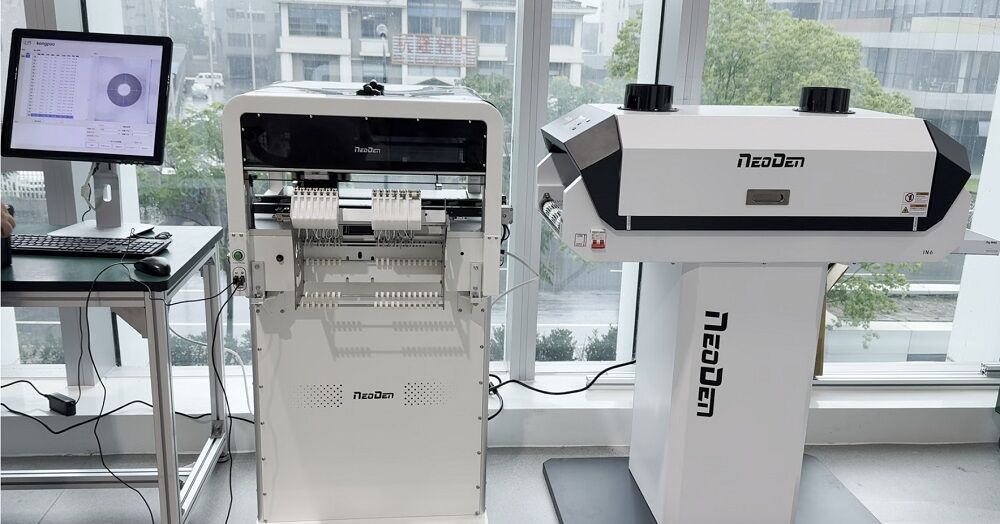
NeoDen IN6 reflow oven features a design with 6 heating zones (3 upper and 3 lower). Combined with full hot-air convection and aluminum alloy heating plates, it can control lateral temperature variations to within ±1°C. The control panel supports 16 sets of programmable temperature profiles.
- Tips for Fine-Tuning Parameters: After enabling "Dynamic Preheating Control" on the IN6 system, thermal equilibrium is reached in approximately 25 minutes, with a temperature control accuracy of ±0.2°C. The conveyor belt supports speed adjustment from 5 to 30 cm/min. Given the net length of the heating chamber is 680 mm, the total time in the oven (min) is calculated as 68.0 cm / conveyor belt speed (cm/min). When testing multi-layer high-density boards and finding that the constant-temperature zone is too short, the most convenient adjustment method is to reduce the conveyor belt speed by 1–2 cm/min on the touchscreen, thereby proportionally extending the substrate's heat absorption time in the oven, without having to modify the set values for each temperature zone individually.
Troubleshooting Common Defects and Routine Maintenance
Based on the soldering defect analysis table in the original manufacturer's manual, process parameter issues can be identified and corrected by analyzing the appearance of solder joints after they exit the oven.
1. Defect Countermeasures
- Flux charring and yellowing of solder joints: Indicates overheating within the oven. This is typically caused by a peak temperature setting that is too high in the reflow zone or by a conveyor belt speed that is too slow, resulting in excessive dwell time. The solution is to increase the conveyor belt speed or lower the set temperature.
- Cold solder joints or incomplete solder joints: This indicates insufficient total heat absorption within the chamber or a "hot air shadow effect" caused by large-volume components. The solution is to first reduce the conveyor speed to extend the heating time. if there are still localized dead spots, appropriately increase the proportion of the bottom heating zone to mitigate the shadow effect by utilizing the temperature difference between the top and bottom.
2. Guidelines for Steady-State Hardware Maintenance
The long-term temperature control stability of a full-hot-air reflow soldering system depends on proper hardware maintenance.
- Drive Bearing Lubrication: Since the interior of the oven is constantly exposed to high-temperature radiation, ordinary lubricating oil tends to carbonize and form deposits, causing the bearings to seize. Seized bearings can cause the mesh belt to vibrate. during the brief moment when the solder paste is in a liquid eutectic state, even slight vibrations can easily cause component displacement or damage the fragile IMC structure. The manual explicitly requires periodic application of high-temperature lubricating oil. It is recommended to service the bearings every 100 hours of operation using high-temperature grease rated for 300°C or higher.
- Fume Filtration System Maintenance: The standard service life of the built-in activated carbon filter cartridge is 8 months. A saturated or clogged filter cartridge will cause increased back pressure in the air duct and a decrease in hot air flow velocity within the chamber. This not only results in uneven heat distribution but also causes the microprocessor's PID temperature control algorithm to respond slowly, leading to fluctuations in the temperature curve. To replace the filter cartridge, simply remove the 12 screws at the rear of the equipment.

Conclusion
Proper calibration of the parameters for the constant-temperature zone and the reflow zone is fundamental to ensuring the reliability of SMT solder joints. By leveraging the NeoDen IN6's multi-temperature-zone hardware architecture and temperature control system, standardizing temperature gradients and conveyor belt speeds, and strictly adhering to daily equipment inspections, you can effectively control process fluctuations and improve the soldering yield during small-batch trial production.