
Types of Soldering
Do you want to solder electronic components on your printed circuit board quickly? Do you find it time-consuming to solder them using the soldering irons manually? It is also unsafe to inhale smoke for a long time. So, who would not want to look for an alternate way of soldering? You just got lucky as there is another standard way of soldering and is super quick. Can you guess what we are talking about? It is wave soldering!
1.Dip Soldering vs. Wave Soldering
In simplest terms, dip soldering is a soldering process with limited scope. Just like wave soldering, it can be used both for surface mount and through-hole circuit board assemblies. Further, the solder rains over the bare metallic areas of the printed circuit board. Thus, you will observe a reliable electrical and mechanical connection. Finally, dip soldering is the manual version of the automatic soldering process.
2. Reflow Soldering vs. Wave Soldering
Reflow soldering is the most famous way of fixing surface mount components onto the printed circuit board. You will need to create a solder paste out of flux and solder powder. And then, you will use that paste to fix electronic components onto the contact pads. You will further heat the whole package under an infrared lamp or in a reflow oven. The solder will then liquefy and make connections between the joints.
On the other side, you can also solder different joints with a hot air pencil. Figure 4 shows the printed circuit board assembling moving into the reflow oven machine.

Now, you must be wondering which technique should be used and when? Generally, wave soldering is more complicated than reflow soldering. In wave soldering, the time for which the PCB stays in the solder wave and PCB temperature require careful monitoring. The printed circuit board can be defective if the soldering environment is not right.
However, with reflow soldering, you don’t need to fret much about environment control. But with this being true, you must know that wave soldering is cheaper and faster than reflow soldering. And, in many applications, wave solder is the only useful way of soldering components onto the board.
You will notice that reflow is mostly used for small-scale applications. Such applications do not need reliable, cheap and fast mass production of PCBs. Surprisingly; you can also use a combination of reflow and wave solder. You can solder components on one side with wave soldering and can use reflow soldering on the other side.
So, these are some alternatives to wave soldering. However, there is still another type of soldering technique that the next chapter compares with wave soldering.
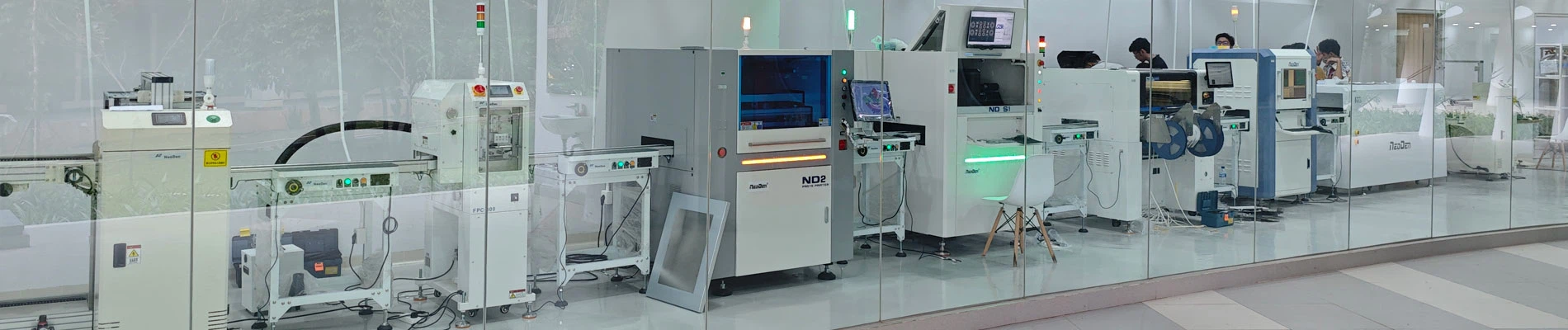
NeoDen provide a full smt assembly line solutions, including SMT reflow oven, wave soldering machine, pick and place machine, solder paste printer, PCB loader, PCB unloader, chip mounter, SMT AOI machine, SMT SPI machine, SMT X-Ray machine, SMT assembly line equipment, PCB production Equipment smt spare parts etc any kind SMT machines you may need, please contact us for more information:
Hangzhou NeoDen Technology Co.,Ltd
Add: Building 3,Diaoyu Industrial and Technology Park,No.8-2,Keji Avenue, Yuhang District, Hangzhou,China
Contact us: Steven Xiao
Phone: 86-18167133317
Fax: 86-571-26266866
Skype:toner_cartridge
E-mail: steven@neodentech.com
E-mail: info@neodentech.com