
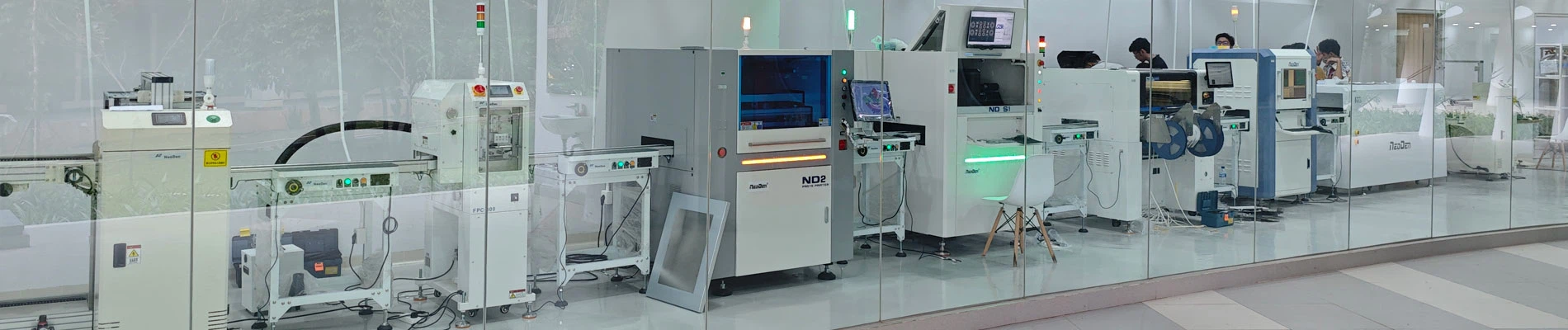
SMT (Surface Mount Technology) is the abbreviation of a series of processes based on PCB. PCB is a printed circuit board. SMT is the most popular technology and process in the electronics assembly industry.

Surface Mount Technology (SMT) is a method of mounting lead-free or short-lead surface-mounted components (SMC / SMD for short, chip components in Chinese) on the surface of a printed circuit board (PCB) or other substrates. Circuit assembly technology for solder assembly by reflow soldering or dip soldering.
Under normal circumstances, the electronic products we use are designed by PCB plus various capacitors, resistors and other electronic components according to the designed circuit diagram, so various electrical appliances need a variety of smt chip processing technology to process.
SMT basic process
Solder paste printing --> Pick and placement --> Reflow soldering --> AOI optical inspection --> Maintenance --> Sub-board.
Electronic products are being miniaturized, and previously used through-hole insert components have been unable to shrink. Electronic products have more complete functions, and the integrated circuits (ICs) used to have no perforated components, especially large-scale, highly integrated ICs, and have to use surface-mount components. Product batching and production automation. The factory must produce high-quality products at low cost and high output to meet customer needs and strengthen market competitiveness. The development of electronic components, the development of integrated circuits (ICs), and the diverse applications of semiconductor materials. The electronic technology revolution is imperative to follow the international trend. It is conceivable that in the case where the production technology of international CPU and image processing device manufacturers such as Intel and AMD are advanced to more than 20 nanometers, the development of smt surface assembly technology and the process is also unacceptable.
- Advantages of SMT chip processing: high assembly density, small size, and lightweight of electronic products, the volume and weight of chip components are only about 1/10 of traditional plug-in components. Generally, after using SMT, the volume of electronic products is reduced by 40% ~ 60 %, Weight reduction 60% ~ 80%. High reliability and strong anti-vibration ability. Low solder joint defect rate. Good high-frequency characteristics. Reduced electromagnetic and radio frequency interference. Easy to implement automation and improve production efficiency. Reduce costs by 30% to 50%. Save material, energy, equipment, manpower, time, etc.
Because of the complex process of smt chip processing, many smt chip processing factories have appeared, specializing in smt chip processing.

Process
SMT basic process includes: solder paste printer (or dispensing), component placement (curing), reflow oven soldering, cleaning, inspection, and repair
- Solder paste printer: Its function is to leak the solder paste or patch glue onto the PCB pads to prepare for the welding of components. The equipment used is a solder paste printer, which is located at the forefront of the SMT production line.
- Dispensing: It is to drip the glue onto the fixed position of the PCB, and its main function is to fix the components to the PCB. The equipment used is a dispenser, which is located at the forefront of the SMT line or behind the inspection equipment.
- SMT Machine Mounting: Its role is to accurately mount surface-mounted components to a fixed position on the PCB. The equipment used is a placement machine, which is located behind the screen printing machine in the SMT production line.
- Curing: its role is to melt the patch glue so that the surface assembly components and the PCB board are firmly bonded together. The equipment used is a curing furnace, located behind the placement machine in the SMT production line.
- Reflow soldering: its role is to melt the solder paste so that the surface assembly components and PCB boards are firmly bonded together. The equipment used is a reflow oven located behind the placement machine in the SMT production line.
- Cleaning: Its function is to remove the welding residues such as flux which are harmful to the human body on the assembled PCB. The equipment used is a washing machine, and the location may not be fixed, online or offline.
- Inspection: Its function is to inspect the welding quality and assembly quality of the assembled PCB. The equipment used is a magnifying glass, microscope, in-circuit tester (ICT), flying probe tester, automatic optical inspection (AOI), X-RAY inspection system, function tester, etc. The location can be configured in the appropriate place of the production line according to the needs of inspection.
- Rework: Its role is to rework the PCB that has failed. The tools used are soldering irons, rework stations, etc. Placed anywhere on the production line.

SMT process
Single-sided board assembly
Incoming inspection => Silk screen solder paste (spot adhesive) => SMD => Drying (curing) => Reflow soldering => Cleaning => Inspection => Rework
Double-sided board assembly
A: incoming inspection => A side screen printing solder paste (spot adhesive) of PCB => B side screen printing solder paste (spot adhesive) of PCB => patch => drying => reflow soldering ( It is better to only clean B side => clean => inspect => repair).
B: incoming inspection => PCB side A screen printing solder paste (point adhesive) => SMD => drying (curing) => A side reflow soldering => cleaning => flip board = PCB B side point SMD Adhesive => SMD => Curing => B-side Wave Soldering => Cleaning => Inspection => Rework)
This process is suitable for reflow soldering on the A-side and wave soldering on the B side. In the SMD assembled on the B side of the PCB, when only the SOT or SOIC (28) pins are below, this process should be used.
Single-sided mixing process
Incoming inspection => PCB side A screen printing solder paste (point adhesive) => SMD => drying (curing) => reflow soldering => cleaning => plug-in => wave soldering => cleaning => inspection = > Rework
Double-sided mixing process
A: Incoming inspection => B-side spot adhesive of PCB => SMD => curing => flip board => A-side plug of PCB => wave soldering => cleaning => inspection => rework
Insert first and insert later, suitable for cases where there are more SMD components than separate components
B: incoming inspection => PCB side A plug (pin bending) => flip board => PCB side spot patch glue => patch => curing => flip board => wave soldering => cleaning => Inspection => Rework
Insert first and paste later, applicable when there are more separated components than SMD components
C: incoming inspection => PCB side A screen printing solder paste => patch => drying => reflow soldering => plug-in, pin bending => flip board => PCB B surface point patch glue => SMD => curing => flap => wave soldering => cleaning => inspection => rework A side mixed, B side mounted.
D: Incoming material inspection => PCB B surface point adhesive => SMD => curing => flip board => A side screen printing solder paste of PCB => SMD => A side reflow soldering => plug-in => B-side wave soldering => Cleaning => Inspection => Rework A side mixed, B side mounted. First stick two-sided SMD, reflow soldering, post-insertion, wave soldering E: incoming inspection => PCB side B screen printing solder paste (point patch glue) => patch => drying (curing) => reflow soldering = > Flip board => PCB side A screen printing solder paste => SMD => Drying = Reflow soldering 1 (local soldering can be used) => Plug-in => Wave soldering 2 (If there are few components, you can use manual soldering) => Cleaning => Inspection => Rework A side mounting, B side mixing.
Double-sided assembly process
A: Incoming material inspection, A-side screen printing solder paste (spot patch adhesive) of PCB, patch, drying (curing), A-side reflow soldering, cleaning, flip; B-side screen printing solder paste (point patch of PCB) Glue), SMD, drying, reflow soldering (preferably only to the B side, cleaning, testing, rework)
This process is suitable for large SMDs such as PLCC mounted on both sides of the PCB.
B: Incoming material inspection, A-side screen printing solder paste (spot adhesive), PCB, drying (curing), A-side reflow soldering, cleaning, flip; B-side spot adhesive, PCB, Curing, B-side wave soldering, cleaning, inspection, rework) This process is suitable for reflow on the A-side of the PCB.
Thin-film printed wiring
This type of thin-film circuit is generally printed on PET with silver paste. There are two process methods for pasting and adhering electronic components on such thin-film circuits. One is called the traditional process method, that is, the 3 glue method (red glue, silver glue, encapsulant) or the 2 glue method (silver glue, encapsulation) Adhesive), another new process is the 1-adhesive method --- as the name suggests, it is to use one adhesive to complete the pasting of electronic components, instead of using 3 or 2 adhesives. The key to this new process is to use a new type of conductive adhesive, which has the conductive properties and process properties of solder paste; it is fully compatible with the existing SMT solder paste operation method when used, without adding any equipment.

Reduce failures
Manufacturing processes, handling, and printed circuit assembly (PCA) testing can put a lot of mechanical stress on the package, which can cause failures. As grid array packages become larger, it becomes more difficult to set security levels for these steps.
For many years, the monotonic bending point test method has been a typical feature of packages. This test is described in IPC / JEDEC-9702 "Monotonic Bending Characteristics of Horizontal Interconnects on Boards." This test method illustrates the breaking strength of printed circuit board horizontal interconnects under bending loads. However, this test method cannot determine what the maximum allowable tension is.
One of the challenges for the manufacturing and assembly processes, and especially for lead-free PCAs, is the inability to directly measure the stress on the solder joints. The most widely used metric used to describe the risk of interconnected components is the tension of the printed circuit board adjacent to the component, as described in IPC / JEDEC-9704 Guidelines for Strain Testing of Printed Circuit Boards.
A few years ago Intel was aware of this problem and started to develop a different test strategy to reproduce the worst-case bending situation in reality. Other companies, such as Hewlett-Packard, have also realized the benefits of other testing methods and are beginning to consider similar ideas to Intel. As more and more chip manufacturers and customers recognize the importance of determining tension limits for minimizing mechanical failures during manufacturing, handling, and testing, this method has caused more and more interest.
As the use of lead-free equipment expands, so does the interest of users; because many users face quality issues.
As interest increased, IPC felt the need to help other companies develop test methods that would ensure that BGAs were not damaged during manufacturing and testing. This work was carried out jointly by the IPC 6-10d SMT Annex Reliability Test Method Working Group and the JEDEC JC-14.1 Substrate Reliability Test Methodology for Packaging Equipment, which has been completed.
This test method specifies eight contact points arranged in a circular array. A PCA with a BGA in the center of the printed circuit board is placed in such a way that the parts are mounted face down on the support pins and a load is applied to the back of the BGA. Place the strain gage adjacent to the part according to the proposed gauge layout of IPC / JEDEC-9704.
The PCA will be bent to the relevant tension level, and the degree of damage caused by flexing to these tension levels can be determined through failure analysis. An iterative method can determine the level of tension without damage, which is the tension limit.
Packaging materials
Packaging materials are usually plastic and ceramic. The heat-dissipating part of the component may consist of metal. The pin of the component is divided into leaded and lead-free.

NeoDen provides a full SMT assembly line solutions, including SMT reflow oven, wave soldering machine, pick and place machine, solder paste printer, PCB loader, PCB unloader, chip mounter, SMT AOI machine, SMT SPI machine, SMT X-Ray machine, SMT assembly line equipment, PCB production Equipment SMT spare parts, etc any kind SMT machines you may need, please contact us for more information:
Zhejiang NeoDen Technology Co., Ltd
Web: www.neodentech.com
Email: info@neodentech.com