
Introduction
Many hobbyists avoid reflow soldering like the plague. Some have never heard about it, others have written it off as too difficult, too much hassle, or unnecessary for their small projects. After diving head first into reflow soldering and surface mount parts, however, we assure you, it is well worth it. After a bit of practice, we actually find that populating and soldering a PCB with surface mounts and reflow soldering is actually faster than it would be for an equivalent through-hole board. In the following sections, we'll share with you the tips, tricks, and techniques that we've picked up through our experience with reflow soldering. It should be noted that we are by no means experts, we are humble hobbyists like yourself and while we have found these things to work for us, they should not be considered to be the "one true way" and that you will very be best served by refining your technique on your own based on your observations.
Selecting components
We've used DigiKey as our primary vendor for our surface mount parts, but there are a number of companies with a large selection of surface mount components. We tend to keep returning to DigiKey because although austere, their site offers some very powerful searching and filtering tools that are simple and reliable. Another good choice for hunting down parts, especially if you're looking to get the best price for a single part is Octopart (octopart.com) which offers aggregate results from a number of vendors.
Most parts that you are used to getting in SIP, DIP, and other through-hole packages will also come in a variety of surface mount packages. In fact, there are some parts that can only be found in surface mount packaging. When selecting parts, you'll want to double check the land pattern recommended by the part and in particular, the package's pitch, or the spacing between the pins. If you get a part with too small of a pitch, you may have a hard time soldering it depending on what methods you are using and your skill and experience with the method. The SOIC package, which is large enough to be hand-soldered, might be a good choice for a beginner.
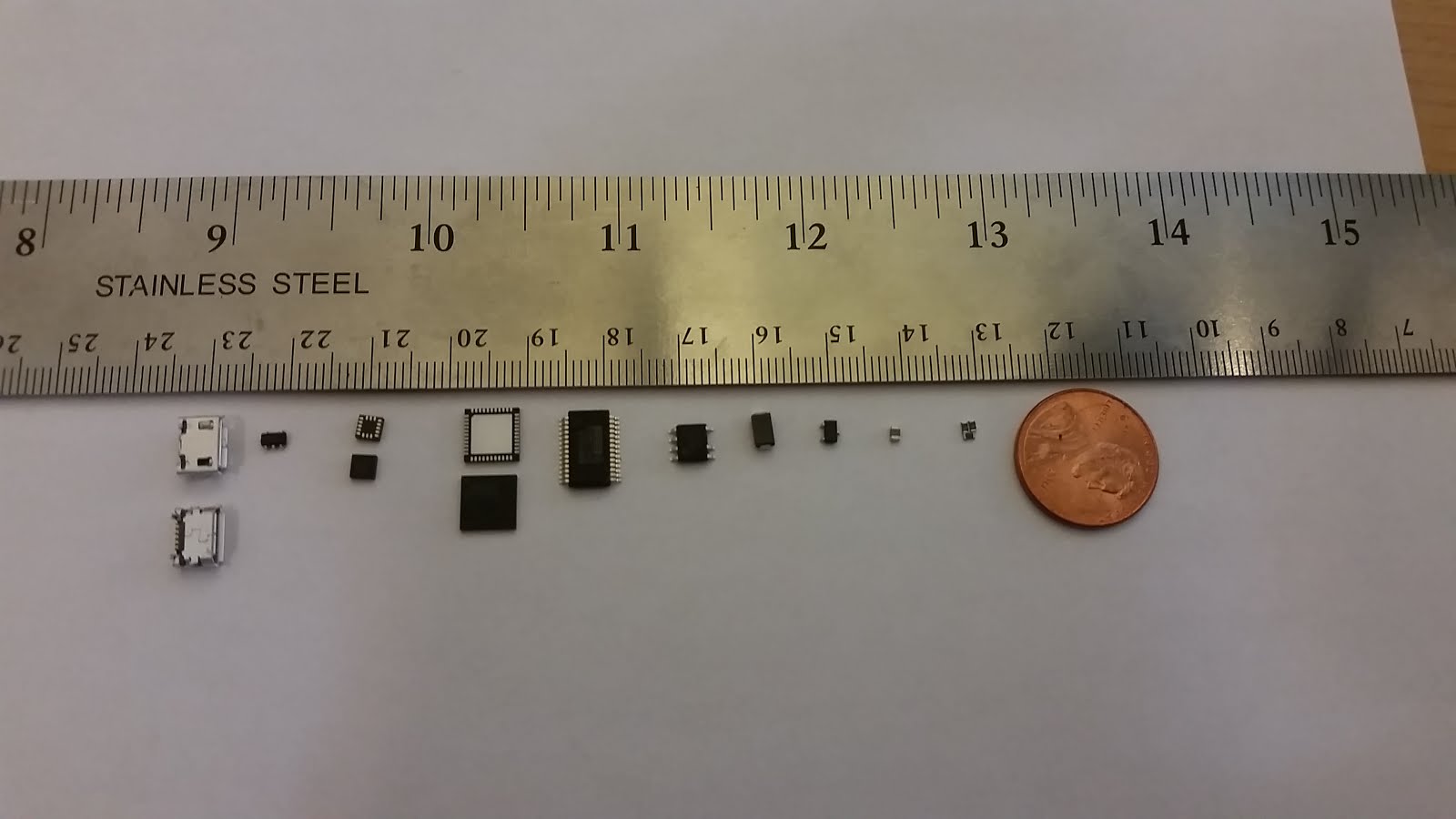
Many passive parts like resistors and capacitors for can be found in a standard 603 package that we've found to be a very good combination of being small enough to allow for very compact circuitry and large enough to be manageable without too much difficulty. If the 603 seems too small too you, try an 805.
Designing a custom printed circuit board
There are a variety of different programs available out there for helping you design your own printed circuit board. They range from the industrial behemoth Altium to the browser-based 123D Circuits by Autodesk. We recommend you choose one that suits your experience, applications, and budget.
Eagle is one of the more popular design programs and offers a free light version for non-commercial use. While powerful, Eagle has a bit of a learning curve to it. If you're looking for the fastest way to get an idea into a PCB with no experience, give 123D Circuits a try.
Fabricating a custom printed circuit board
Once you've designed your circuit board and checked it thrice, it's time to get it fabricated. Where a few years ago our options were limited to hand-etching your own circuit board, these days you can submit Gerber files to a service online and have your custom circuit board in the mail a few days or weeks later (depending on how much you want to spend).

Sometimes exporting Gerber files can be a little tricky, so we've been using a nifty program called "gerbv" (gerbv.sourceforge.net) to verify our Gerber and NC Drill files. It's lightweight and free, and it's a good sanity check to make sure all your layers are lined up.
We've been using Seeed Studio for our circuit boards and have been very pleased with the quality and price of the circuit boards. They are, however, located in China and will often take a few weeks to arrive here in the US. A potential alternative, especially for Europe residents is Mint Tek.
Regardless of which service you use, be sure to double check the manufacturer specifications for your chosen provider. Each manufacturer will have slightly different minimum trace, silkscreen, and hole sizes. Usually getting this wrong simply means that they'll email you asking for a resubmission that fits the constraints.
Applying solder paste by hand
Solder paste is a viscous suspension of solder particles in flux. It typically comes in tubes or small tubs. While most high-volume production lines will apply solder paste using a stencil, for a hobbyist, it is quite reasonable to apply the paste by hand.
When applying solder paste by hand, you'll want to try to aim for as much consistency as possible for the amount of solder paste per square millimeter of pad (or contact). While that may sound intimidating, usually this means sorta smearing a glob of solder paste across a pad or briefly dabbing a drop of paste against it. The amount of solder paste you'll want to apply will vary slightly based on the footprint of the component you are trying to solder. 603s and 805s will not only sustain, but benefit from having slightly more solder paste on each contact where a dense package like a QFN will solder best when a very thin smear of solder paste is used.

With experience, you'll get a better feeling for the optimal amount of solder paste for different components, but our general advice is to err on the side of too little solder paste than too much solder paste.
NeoDen provide a full smt assembly line solutions, including SMT reflow oven, wave soldering machine, pick and place machine, solder paste printer, PCB loader, PCB unloader, chip mounter, SMT AOI machine, SMT SPI machine, SMT X-Ray machine, SMT assembly line equipment, PCB production Equipment smt spare parts etc any kind SMT machines you may need, please contact us for more information:
Hangzhou NeoDen Technology Co.,Ltd
Add: Building 3,Diaoyu Industrial and Technology Park,No.8-2,Keji Avenue, Yuhang District, Hangzhou,China
Contact us: Steven Xiao
Phone: 86-18167133317
Fax: 86-571-26266866
Skype:toner_cartridge
E-mail: steven@neodentech.com
E-mail: info@neodentech.com