
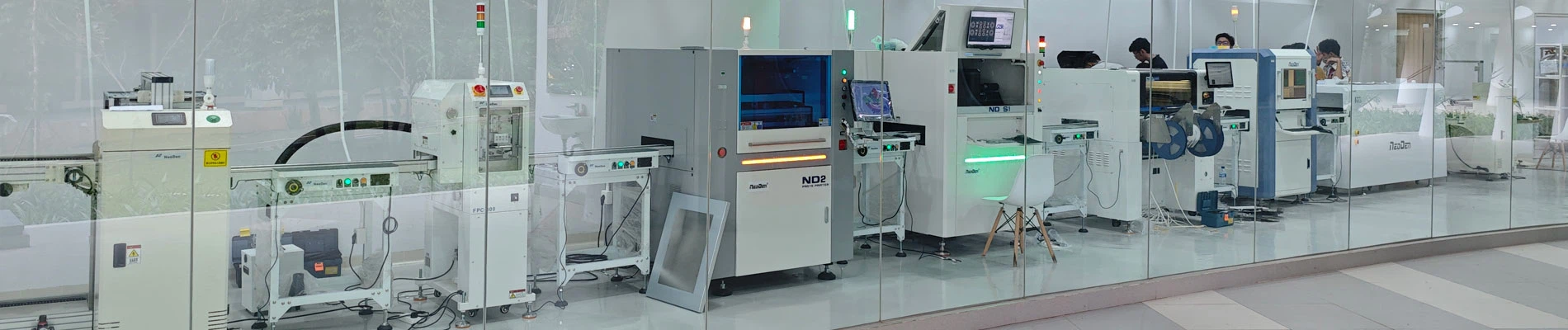
In PCBA processing, the soldering process affects the connection quality and stability of circuit board components. Optimizing the soldering process can improve product quality, reduce production costs, and ensure product reliability and stability.
I. Select the appropriate soldering method
I. Surface Mount Soldering
SMT soldering is currently a commonly used welding method in PCBA processing. It uses electromagnetic induction or hot air, etc., to weld components on the PCB surface, with the advantages of fast welding speed and uniform solder joints.
2. Wave soldering machine soldering
Wave soldering is suitable for mass production and multi-layer PCB board welding. It realizes welding by immersing the PCB board into the solder wave, which has the advantages of high automation and fast welding speed.
3. Hot Air Soldering
Hot air welding is suitable for small batch production and special PCB board welding. It heats up the solder by hot air, melts the solder and connects it with PCB board and components, which has the advantages of high flexibility and adaptability.
II. Fine adjustment of soldering parameters
1. Temperature control
Control of welding temperature is one of the key factors to ensure the quality of welding. Reasonable setting of the welding temperature to avoid too high a temperature leading to oxidation of the solder joints or too low a temperature affecting the quality of welding.
2. Time control
Soldering time also needs to be finely adjusted. Too long welding time may lead to component damage or PCB board overheating, while too short welding time may lead to weak welding.
3. Soldering speed
Soldering speed also needs to be adjusted according to the actual situation. Too fast welding speed may lead to uneven welding, while too slow welding speed will increase the production cycle.
III. Optimize welding equipment
1. Updating equipment
Timely updating of welding equipment is the key to keep the welding process optimized. Choosing welding equipment with advanced performance, high precision, stability and reliability can improve production efficiency and welding quality.
2. Do a good job of equipment maintenance
Regular maintenance and repair of welding equipment to ensure that the equipment is in good working condition. Timely replacement of damaged parts to ensure the normal operation of the equipment, to avoid production interruptions and welding quality problems caused by equipment failure.
IV. Increase the inspection link
Automatic Optical Inspection (AOI) technology is adopted to carry out comprehensive inspection of PCB boards after welding. Through the high-resolution image recognition technology, detect the welding quality, timely detection and repair of welding defects, improve product quality.
2. X-ray inspection
For some precision components and difficult to directly detect the welding point, you can use X-ray inspection technology. Through X-ray fluoroscopy, the connection and quality of the welding points are detected to ensure that the welding quality meets the standard requirements.
V. Training of operators
Optimizing the welding process not only requires advanced equipment and precise parameter adjustment, but also requires operators with professional skills and experience. Regular training and assessment of operators to improve their welding technology and operation level to ensure welding quality.

Features of NeoDen ND800 SMT AOI Machine
Inspection Items
1) Stencil printing: Solder unavailability, insufficient or excessive solder, solder misalignment, bridging, stain, scratch etc.
2) Component defect: missing or excessive component, misalignment, uneven, edging, opposite mounting, wrong or bad component etc.
3) DIP: Missing parts, damage parts, offset, skew, inversion, etc
4) Soldering defect: Excessive or missing solder, empty soldering, bridging, solder ball, IC NG ,copper stain etc.
Specification
| Product name | NeoDen ND800 AOI Inspection Machine | PCB height from ground | 900±20mm |
| Model | ND800 | Machine dimension | L980 * W980 * H1620 mm |
| PCB Thickness | 0.3mm~5mm | XY positioning accuracy | ≦8um |
| Max. PCB Size (X x Y) | 400mm x 360mm | Power | AC220V,50/60Hz,1.5KW |
| Min. PCB Size (Y x X) | 50mm x 50mm | Weight | 550Kg |
| Moving speed | 830mm/Sec(Max) |