
Common roles of resistors in series.
Because the impedance of the signal source is very low, and the impedance between the signal line does not match, after the series of a resistor, you can improve the matching situation to reduce reflections, to avoid oscillations, etc..
Common impedance matching methods
1. Use transformer to do impedance conversion.
2. the use of series / parallel capacitors or inductors, which is often used in debugging RF circuits.
3. using the approach of series/parallel resistors. Some drivers have a relatively low impedance, you can connect a suitable resistor in series to match the transmission line, such as high-speed signal lines, sometimes in series with a few dozen ohms of resistance. And some receivers are higher input impedance, you can use the parallel resistor method to match with the transmission line, for example, 485 bus receiver, often in parallel with the data line terminal 120 ohms matching resistor.
4. change the impedance force. Adjust the load impedance value through series and parallel connection of capacitors, inductors and loads to achieve source and load impedance matching.
5. Adjust the transmission line. Adjusting the transmission line is to lengthen the distance between the source and the load, with capacitors and inductors to adjust the impedance force to zero. At this point, the signal will not be emitted, the energy can be absorbed by the load. High-speed PCB wiring, the general alignment impedance of the digital signal is designed to 50 ohms. The general rule is that coaxial cable baseband 50 ohms, frequency band 75 ohms, twisted pair (differential) for 85-100 ohms.
Because the series resistor, with the signal line distribution capacitance and load input capacitance, etc. to form an RC circuit, which will reduce the steepness of the signal edge. As you know, if the edge of a signal is very steep, containing a large number of high-frequency components, will be radiation interference, in addition, also easy to generate overshoot.
Usually, the use of such a resistor is considered only in high-speed signal lines. In the low frequency case, it is usually a direct connection.
The next section will explain the role of resistor series connection with specific cases.
1. SPI signal line

SPI signal on the series resistor, generally a few tens of ohms or so, generally have the following roles.
a. impedance matching. Because the impedance of the signal source is very low, and the impedance between the signal line does not match, after the series of a resistor, can improve the matching situation to reduce reflections.
b. the SPI rate is high, a resistor in series, with the line capacitor and load capacitance to form an RC circuit to reduce the signal steepness and avoid overshoot, overshoot can sometimes damage the chip GPIO, of course, the EMI is also good, especially high-speed circuit.
c. debugging convenience, many of the chips are now BGA, QFN package, a resistor in series, debugging with an oscilloscope to capture the waveform is convenient.
2. LDO input
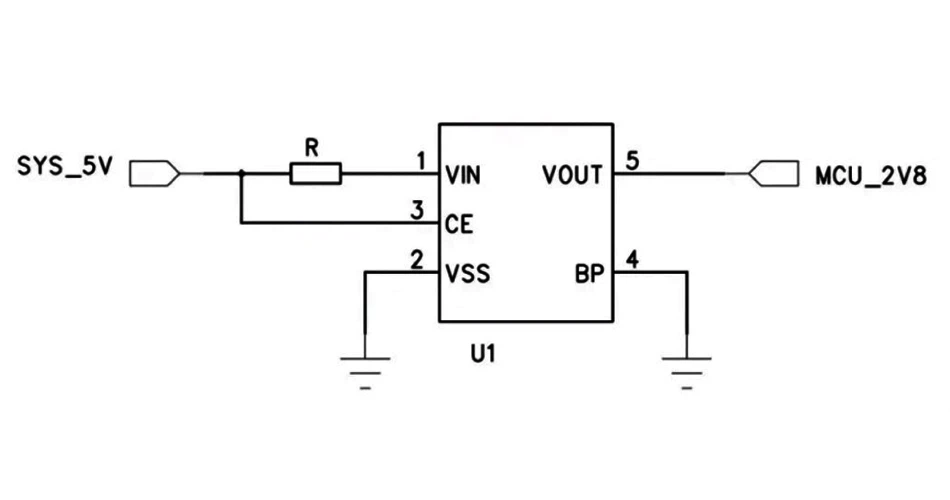
When the LDO VIN absolute maximum close to the power supply voltage, at this time and do not want to change the high specification LDO, in order to save costs, then you can string a small resistance resistor, can absorb part of the voltage and current, when the power supply side of a larger surge, the resistor will be preceded by a smaller cost.
Suppose LDO breakdown, VIN and GND short circuit, because of the presence of series resistor R, will also avoid the power supply SYS_5V and GND short circuit.
3. TVS before and after the series resistor


TVS series resistors are generally connected in two ways, the first figure resistor in front of the TVS, the second figure resistor after the TVS, the two circuit use scenarios are not the same.
a. For the first figure, first consider the size of the surge, if not large, you can choose a suitable power resistor, the resistor in front of the TVS, will absorb a very small part of the current, after the surge current IPP small, corresponding to the TVS Vc (clamp voltage) will also become smaller, better protection for the back-end load.

b. for the second figure, the TVS first absorb most of the inrush current, part of the residual voltage or residual current, will pass through the resistor R2, the secondary voltage divider current limit, can better protect the rear-end load. If the back-end load is much larger than R2, voltage divider current limiting will be minimal, R2 actually has no role.