
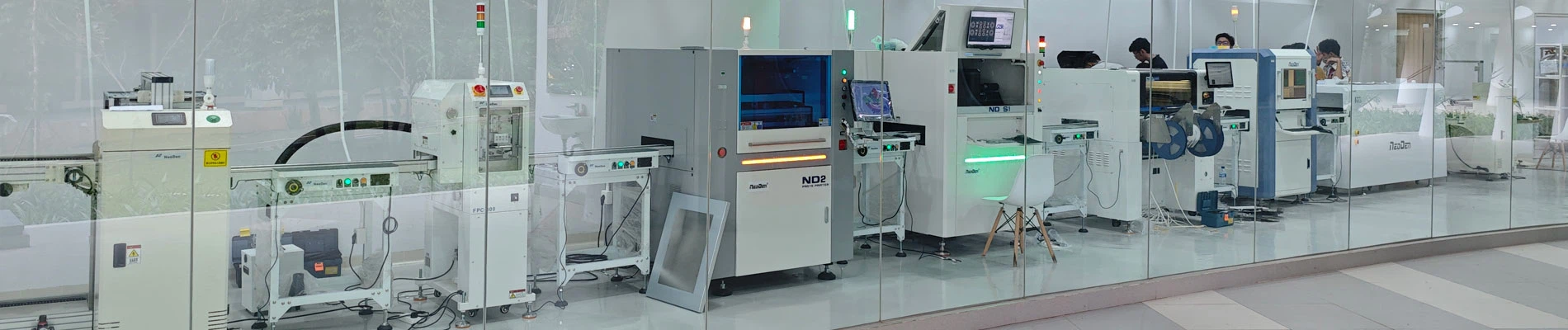
A brief description of the development of wave soldering machine
Wave soldering is the soft brazing of molten solder (lead-tin alloy) by electric or electromagnetic pump jet into the design requirements of the solder wave, can also be formed by injecting nitrogen into the solder pool, so that the pre-installed components of the printed board through the solder wave, to achieve the mechanical and electrical connection between the solder end of the components or pins and the pads of the printed board soft brazing.
Wave soldering process: inserting the component into the corresponding component hole → pre-application of flux → pre-heating (temperature 90-100°C, length 1-1.2m) → wave soldering (220-240°C) cooling → cutting off excess insert pins → inspection.
The reflow soldering process is a soft brazing of mechanical and electrical connections between the solder ends of surface assembly components or pins and printed board pads by re-melting the paste soft brazing solder pre-distributed to the printed board pads.
Wave soldering has a new welding process as people become more aware of environmental protection. Previously, tin-lead alloys were used, but lead is a heavy metal that can do great harm to the human body. This has led to a lead-free process, using a *tin-silver-copper alloy* and special fluxes, and a higher preheating temperature is required for the soldering temperature.
Perforated (TH) or hybrid technology circuit boards are still used in most products that do not require miniaturisation and high power, such as televisions, home audio-visual equipment and digital set-top boxes, which still use perforated components and therefore require the use of wave soldering. From a process point of view, wave soldering machines offer only a small amount of adjustment to the most basic machine operating parameters.
The wave soldering machine process
Once the board has entered the wave soldering machine via the conveyor belt, it passes through some form of flux application unit where the flux is applied to the board using wave, foam or spray methods. As most fluxes must reach and maintain an activation temperature during soldering to ensure complete wetting of the solder joint, the board passes through a pre-heating zone before entering the wave bath. The pre-heating after flux application gradually raises the temperature of the PCB and activates the flux. This process also reduces the thermal shock generated when the assembly enters the wave crest. It can also be used to evaporate any moisture that may be absorbed or carrier solvents that dilute the flux, which, if not removed, can boil off and cause solder spatter as it passes through the waveform, or generate vapours that remain inside the solder to form hollow solder joints or grit. In addition, because of the higher heat capacity of double-sided and multilayer boards, they require higher preheating temperatures than single-sided boards.
The most commonly used methods of wave soldering preheating are forced hot air convection, electric heating plate convection, electric heating rod heating and infrared heating. Of these methods, forced hot air convection is generally considered to be the most efficient method of heat transfer for wave soldering machines in most processes. After preheating, the board is soldered with either a single wave (λ-wave) or a double wave (scrambled and λ-wave). A single wave is sufficient for perforated components. When the board enters the wave, the solder flows in the opposite direction of the board's travel, creating eddy currents around the component pins. This acts as a scrubbing brush, removing all residues of flux and oxide film from the top, creating a dip when the solder joint reaches the dip temperature.
For hybrid technology assemblies, a scrambled wave is also generally used before the λ wave. This wave is narrower and disturbed with a higher vertical pressure, which allows the solder to penetrate well between the compactly placed pins and surface mounted component (SMD) pads, and then the λ wave is used to complete the solder joint formation. All technical specifications of the board to be soldered with the wave need to be determined before any evaluation of future equipment and suppliers, as these can determine the performance of the required machine.
